
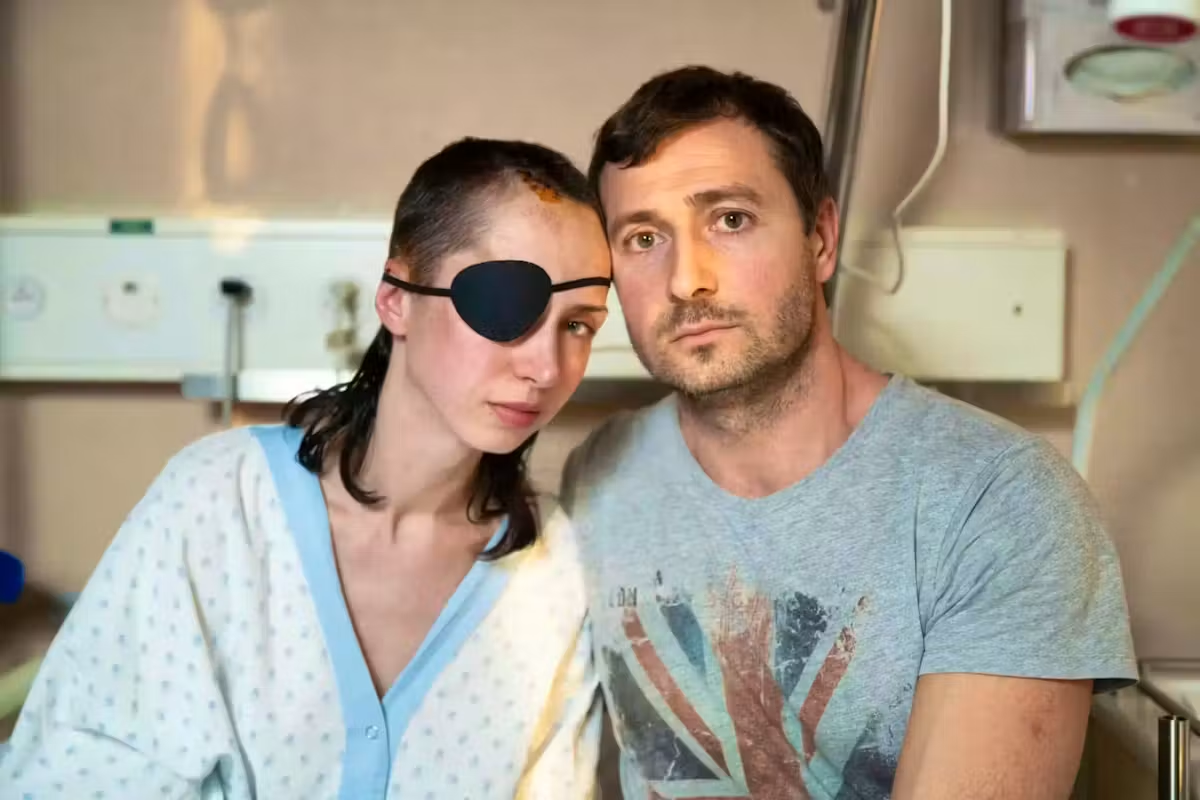
Five defendants were awaiting a verdict in the case of the fall of Russian skater Olga Sevastianova on the sidelines of the Youth Olympic Games (YOG) in Lausanne in 2020. Who are responsible for the serious injuries suffered by the skater six years earlier? This is the question that was at the heart of the trial.
Absent during the reading of the verdict at the Montbenon courthouse this Monday, the ex-skater and her husband Sergii Sevastianov were at the center of an astonishing legal scenario, since the victim’s husband was among the defendants. In 2020, it was in fact he who, assisting his wife, was responsible for activating the machinery supposed to lift her into the air during the show. As a reminder, the acrobat had fallen during a rehearsal, while a winch, fixed to the ceiling, had malfunctioned.
Three acquitted and two convicted
Considered to have no technical knowledge, Sergii Sevastianov was ultimately acquitted. Two of the remaining defendants were also cleared, the investigation having concluded that they were not responsible for the accident. Unlike the two convicted defendants. Respectively technical director of the company commissioned for the installations for one, and specialist in the “rigging” technique – a method of suspending artists in the air – for the other, they will both receive a 180-day suspended fine.
For the Court, Sergii Sevastianov therefore simply brought his equipment and piloted it, and he should have been able to rely on the technicians on site for its installation. They having refused the two requests of the spouses – that the acrobat could be visible to her husband during his performance and that the winch be installed on the ground as it had been during their 200 previous performances -, in a logic linked to the “contingents of the show and the ceremony as a whole”, they then failed in the safety of the artist, according to the court verdict.
Direct link between installation and fall
To the argument that the accident was not foreseeable, the judge opposed the expert report which underlines that there is “a direct link between the non-compliant installation and the fall” of the skater and that “the accident could have been avoided if the winch had been installed in accordance with its user manual”. This had not been requested by the technical managers.
The couple was also told that, having noticed during rehearsals that the winch would be located high up and not on the ground, they could have refused the situation. To this, the president conveyed that such a refusal would have deprived the artist, enjoying “limited notoriety”, of an opportunity, which in view of her acceptance of low remuneration for her performance during the YOG 2020, was important to her.
Reading of the contested expert report
In view of the physical and psychological suffering resulting from her fall, as well as its impact on her employment, the court ruled that the plaintiff deserved compensation for moral harm in the amount of 50,000 francs, which the two convicted persons will have to share. “My client was acquitted on the basis of convincing legal reasoning,” Mr. Julien Gafner, the husband’s lawyer, declared to the media as he left the court.
An observation not shared by Mirjam Richon-Bruder and Jean-David Pelot, lawyers for one of the convicted defendants, who have indicated that they are appealing. “We do not have the same reading of the expert report,” they declared. Well aware of the tragic consequences of this accident on the couple’s life, they nevertheless consider that contradictory statements from Sergii Sevastianov – who first indicated to the technicians that his winch had sometimes been installed at height before reversing his remarks – were not accepted by the court. “This case contains a very emotional aspect, but criminal law unfortunately does not deal with emotion.”
