
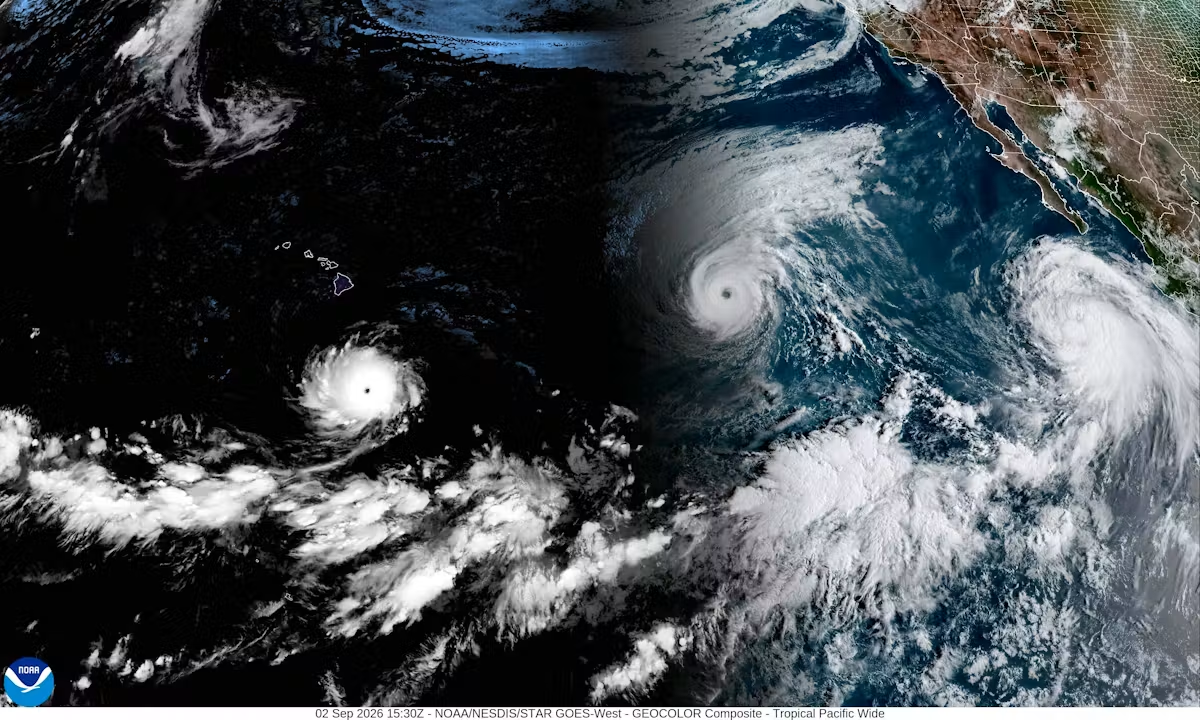
Two powerful hurricanes and a strengthening tropical storm cross the Pacific Ocean on Wednesday, whose waters are being warmed by an El Niño episode of historic intensity. Hurricane Lowell upgraded to Category 5, the highest, on Wednesday as it moves west, followed by Hurricane Karina (Category 4). Both are expected to pass far from the coast of Hawaii, according to the US National Hurricane Center (NHC).
“Swells generated by Lowell are propagating northward and will impact parts of the Hawaiian Islands over the next few days,” the NHC said, however, which could lead to dangerous conditions near the coast.
Hawaii is still recovering from Hurricane Lala, which caused flooding in mid-August. Lowell and Karina are followed by Tropical Storm Marie, currently located a few hundred kilometers from the Mexican coast and “expected to become a hurricane later today,” according to the NHC.
Rare phenomenon favored by El Niño
“The warming linked to El Niño creates the conditions conducive to these storms, which are fueled largely by warm waters,” said Julia Cole, climatologist at the University of Michigan, to AFP. A sequence of three storms “is certainly rare to observe,” she adds. A similar succession of four cyclones occurred in 2015, another year marked by an intense El Niño.
“The climate system has really warmed over the last twenty years,” says Benjamin Kirtman of the University of Miami, emphasizing that the temperature of surface waters is already at near-record levels.
According to the National Oceanic and Atmospheric Administration (NOAA), this year’s El Niño has a 69 percent chance of becoming the most intense on record. It is already causing extreme weather events across the world, although it is only expected to peak around November.
A climatic phenomenon that occurs every two to seven years, it occurs when the easterly winds that normally hold warm waters in the western Pacific temporarily weaken, allowing them to rise to the surface and move eastward.
When surface temperatures remain above normal for several months, it causes more storms over the region, which impacts the entire Earth’s atmosphere. As a result, the climate becomes hotter and drier in some places, and cooler and wetter in others.
Scientists agree that climate change is amplifying the effects of El Niño. There is no consensus on whether climate change itself strengthens El Niño, although evidence is beginning to emerge.
