
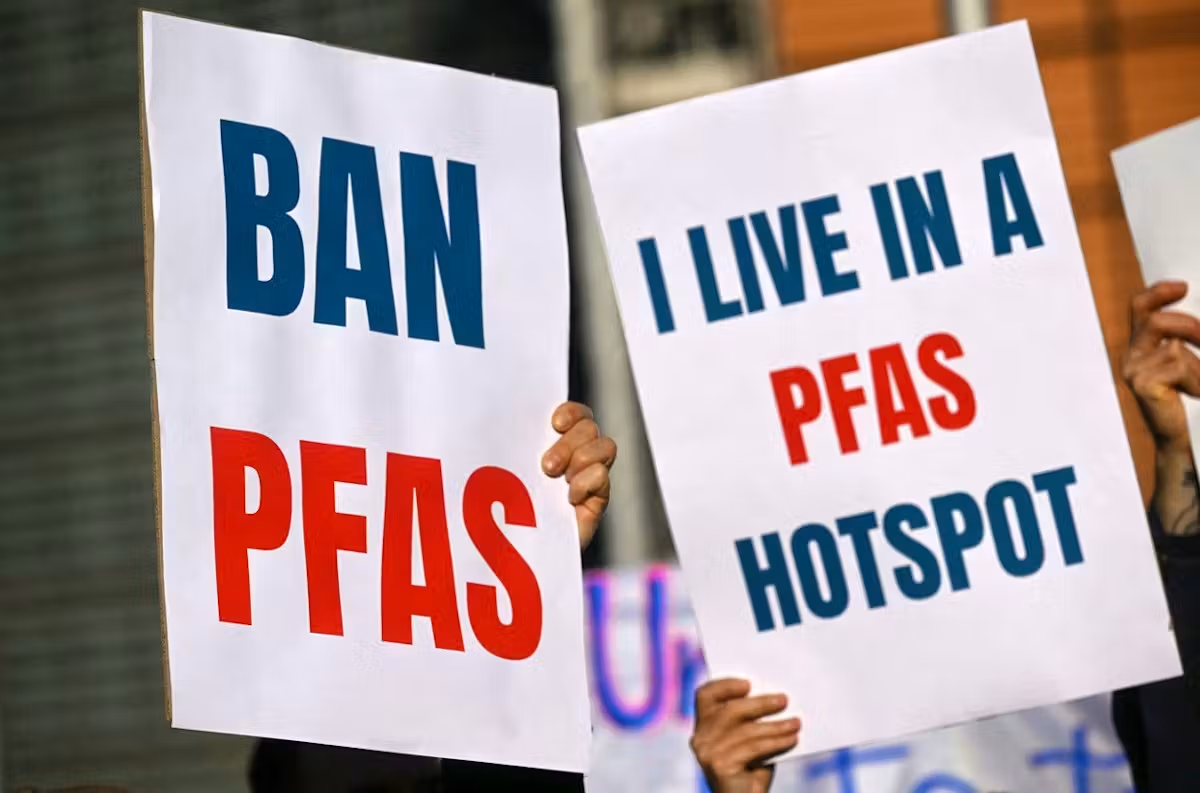
The recent approval by the American government of several new pesticides worries scientists and environmental associations, who believe that these substances are in reality PFAS, nicknamed eternal pollutants, with increasingly restricted use in Europe.
PFAS are man-made synthetic chemicals, found in everything from rain jackets to Teflon non-stick pans to agricultural pesticides. But there is debate over the definition of what constitutes PFAS.
The five recently authorized substances do not fit into the definition of PFAS adopted by the American federal authorities. For many experts, these products are indeed eternal pollutants and they warn of the danger of these new pesticides for the environment. AFP takes stock of this debate.
Classification question
PFAS are characterized by their chemical structure: they contain very stable carbon-fluorine bonds. Their resistance to corrosion, light or high heat make them excellent insulators, non-stick or waterproofing agents.
A definition of what constitutes PFAS, based on their chemical structure and adopted by the OECD in 2021, was followed by about half of American states, Congress and the Pentagon, as well as by a group of 150 scientists in a consensus announced in 2024.
But in 2023, the US Environmental Protection Agency (EPA) chose its own, more restrictive definition.
Under Joe Biden’s mandate, when this definition was adopted, only one pesticide was approved, compared to five since Donald Trump’s return to power.
The EPA now emphasizes that these pesticides are authorized in other countries and are essential for food safety.
Tip of the iceberg
But for scientists and environmental activists, the new substances authorized because of this restrictive classification still present dangers for humans and the environment.
There is “evidence that suggests a carcinogenic potential,” the EPA itself recognized in its evaluation of one of the newly authorized herbicides, trifludimoxazin.
And these new authorizations represent only the tip of the iceberg: an analysis carried out in 2024 on substances already authorized in the United States and Canada concluded that 66 of them were PFAS, according to the OECD definition.
“This is a problem that has been swept under the rug by successive governments,” denounces Nathan Donley of the environmental association Center for Biological Diversity. “But it’s getting worse today.”
Out of ten peaches purchased commercially in the United States, “there is a good chance that nine have very toxic PFAS residues,” warns Varun Subramaniam, who conducted analyzes for the NGO Environmental Working Group.
Many of these pesticides break down into TFA, a ubiquitous pollutant in water.
At the end of July, the European Food Safety Authority tightened its recommendations on the admissible doses of this extremely persistent substance which is found in soil, groundwater, agricultural crops, and ultimately, in drinking water and human food.
Lobbyists
NGOs have criticized strong ties between the industry and American regulators.
EPA chief Lee Zeldin in November had the agency’s PFAS and pesticides web page changed to remove any mention of a broader definition of perennial pollutants, according to public documents obtained by the Center for Biological Diversity.
The same day, the US pesticide industry lobby, CropLife America, published an anti-regulation pitch that cited the newly revised page. The lobby told AFP that there was no coordination.
A debate that reminds Cindy Hu, an environmental sciences researcher at George Washington University, of previous episodes. When the first generation of PFAS was phased out in the early 2000s, the industry replaced them with other molecules sold as safer.
But one of them has since caused significant contamination in drinking water in North Carolina.
“It’s a new version of the same story,” she laments, defending a precautionary principle according to which these chemical substances should be considered dangerous, unless proven otherwise.
