
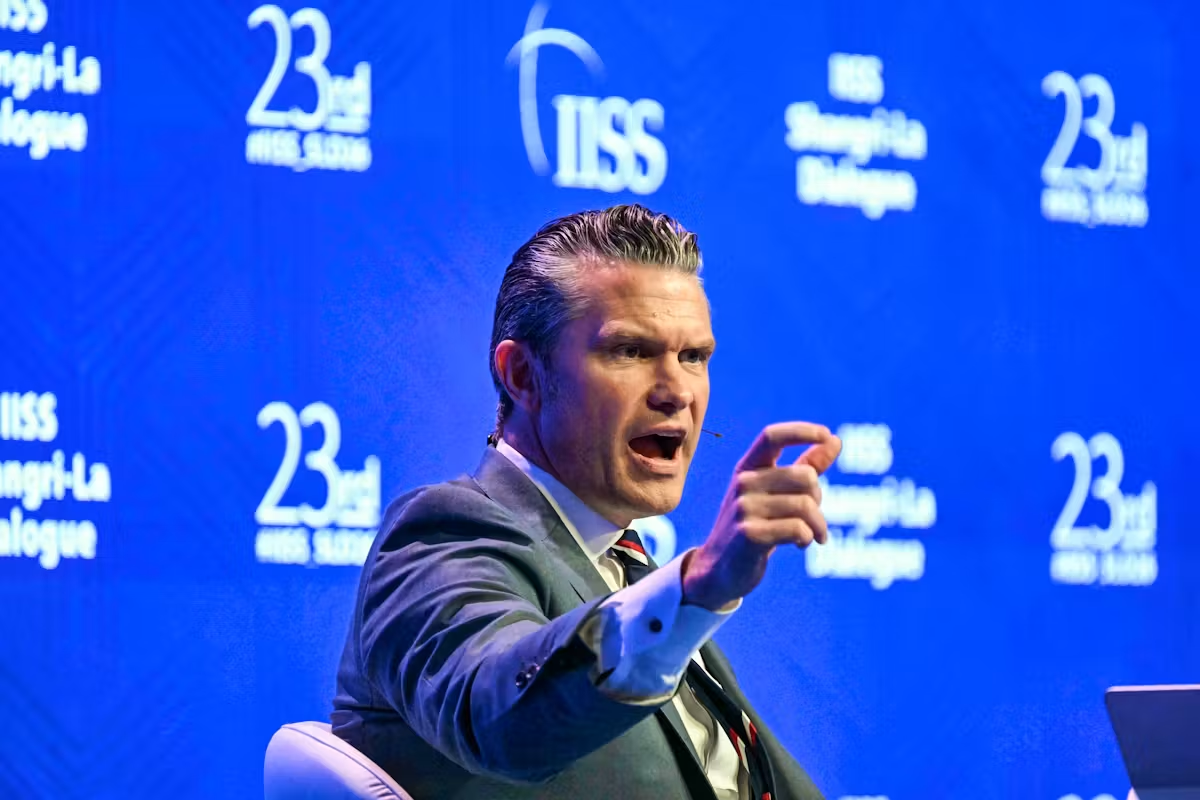
In front of an audience of military officials gathered at the Shangri-La Dialogue, a major defense forum organized in Singapore, he also assured that the United States wanted a “stable balance” in the Asia-Pacific.
Pete Hegseth did not fail to scratch China. But two weeks after a meeting in Beijing between Donald Trump and President Xi Jinping, he seemed to want to extend the momentum of bilateral appeasement by refraining from the particularly acerbic comments he had made last year.
The head of the Pentagon came to Singapore with an imposing delegation, but China for the second year in a row sent a simple team of military experts, without sending its Defense Minister, Dong Jun.
“Looking at the region today, there is legitimate cause for alarm at the historic scale of China’s military buildup,” Pete Hegseth said on Saturday.
The United States, however, does not want “useless confrontation” in the Asia-Pacific but “truly a stable balance, which works both for the Americans and for our allies,” he stressed.
He praised “a favorable but lasting balance of power, in which no state, including China, can impose its hegemony or threaten the security or prosperity of our nation and our allies.”
“Ironic”
Beijing is particularly opposed to Washington on the highly sensitive issue of the island of Taiwan, which China intends to “reunify” with its territory in the name of historical reasons.
Despite frictions, the United States is seeking a “respectful” and “good faith” dialogue with the Asian giant, said Mr. Hegseth.
His visit to Singapore comes two weeks after a visit by Donald Trump to China.
The American president had claimed the conclusion of “fantastic” trade agreements and implied that American arms sales to Taiwan could be used as a means of pressure on Beijing.
There has been “no change” in Washington’s position on Taiwan, but “any decision concerning future arms sales to Taiwan (…) will be up to” Mr. Trump, Mr. Hegseth said on Saturday.
The Pentagon chief’s comments contrast with those, much more virulent, that he made last year, where he clearly portrayed China as a threat.
General Meng Xiangqing, head of the Chinese delegation, said this year’s speech reflected the results of the meeting between Trump and Xi.
“This demonstrates once again that stable relations between the United States and China are not only beneficial for both peoples, but also for regional stability and global peace,” he said.
His speech on Saturday is “much more moderate,” says Da Wei, Chinese delegate to the Shangri-La Dialogue and director of the Center for International Security and Strategy at Tsinghua University (Beijing).
However, he found it “ironic” that Pete Hegseth, whose country launched a war against Iran, would imply that China has hegemonic aims.
“Everyone in the room must have been thinking: who is really hegemonic?” says Da Wei.
“Which country does not respect sovereignty? With what the United States is doing in Iran, has done in Venezuela, I think the answer is clear,” he emphasizes.
Threat against Iran
Pete Hegseth once again urged the United States’ allies on Saturday to spend more on their defense, welcoming in particular South Korea, Japan, Australia and the Philippines, while threatening consequences against countries which “profit freely from the generosity of the American taxpayer.”
“Those days are gone. Allies who refuse to step up and shoulder their share of the burden for our collective defense will face a clear change in the way we do business,” he stressed.
The Shangri-La Dialogue comes amid uncertainty over the outcome of negotiations between the United States and Iran.
A White House official assured Friday that Donald Trump will only sign an agreement if his “red lines are met.” Tehran affirmed that “no final agreement has yet been reached”.
Pete Hegseth said on Saturday that the United States was “fully capable” of resuming hostilities if necessary.
Furthermore, Mr. Hegseth and his British and Australian counterparts announced that they would join forces under their “Aukus” military cooperation agreement to develop payloads for underwater drones.
