
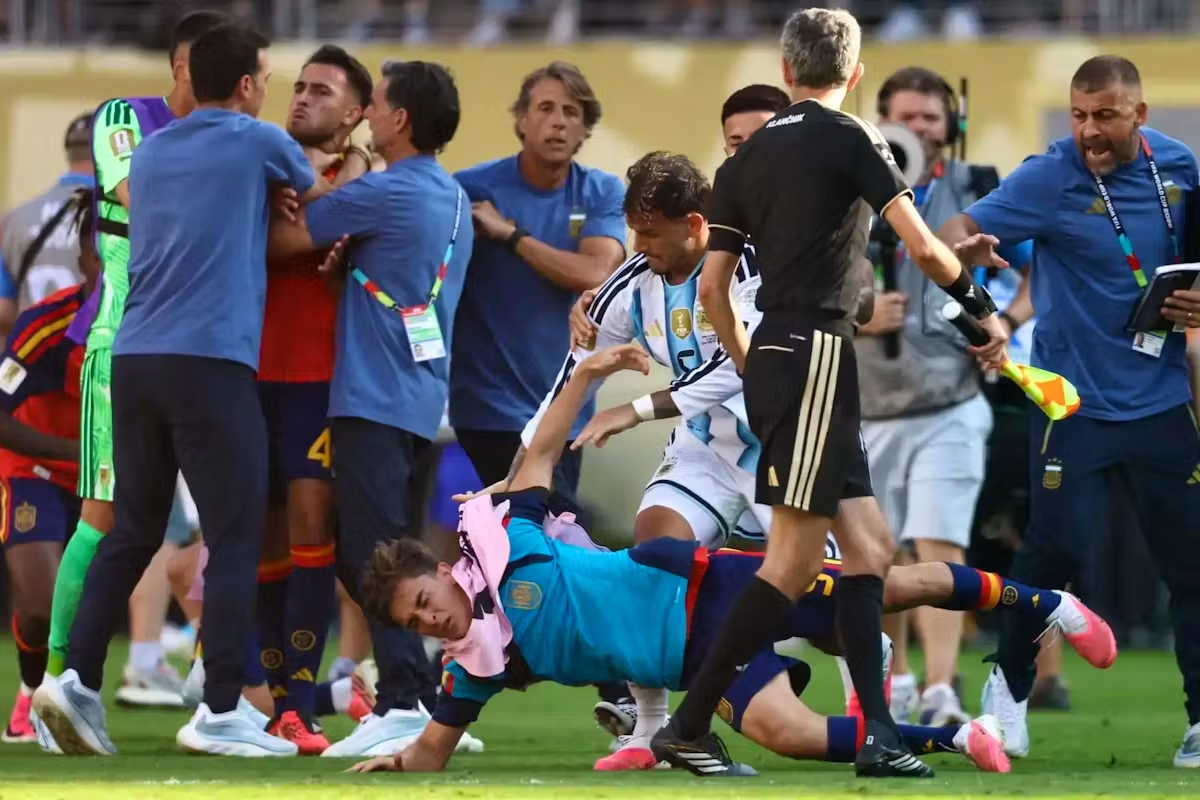
Completely disappointed, in their nostalgic gratitude for a Messi at the end of his race, Argentine supporters are indifferent, even defiant, in the face of criticism of their Seleccion – which a Fifa investigation could target – and his attitude, speaking of “pride” when they hear “arrogance”.
In the international press and on social networks, a flood of hostile comments accompanied the Abiceleste and its defeat against Spain. Sometimes castigating his “negative”, “minimalist”, “destructive” game, or his “cynical”, “provocative”, even violent attitude.
“Football 1, Offenders 0” headlined London’s Daily Telegraph, while the New York Times opined that “Argentina dishonored itself, and the final, with its graceless petulance”. She “paid the price for wanting to turn a football match into a street brawl,” asserts The English Sun.
Did you say catchy, harsh, rough? So many virtues of their Seleccion in the eyes of the Argentines, proud and moved by its resilience and its “comebacks” against Egypt (from 0-2 to 3-2), Switzerland (3-1) or even more the hated England (from 0-1 to 2-1).
Monday evening, at the domain of the Federation (AFA) in Ezeiza, among the thousands of hinchas waiting in the rain to celebrate the selection on its return, foreign hostility towards the Argentine team was perceived, but experienced without difficulty.
“We are criticized because we know what it is to suffer, to get up, to fall again, to continue life like this, because yes, being Argentinian is blood, it is heart, love,” Marga Ledezma, a 36-year-old housewife, told AFP.
Never any gifts
“The Argentinian is a fighter. No one gives us anything, ever. And the criticism is because they don’t know how to wet their jerseys like these players did.
In the media and social networks, the defense of “Argentinianness” has become heated in recent days.
“There’s something about Argentinian irreverence that they can’t stand,” famous radio host Pedro Rosemblat wrote on Instagram. “Our rebellion exasperates them, confronts them with their own cowardice. They call us cancheros (rogues), cheats, dirty. And we love it.”
To a recent column in the New York Times, before the final, which identified the Albiceleste as the “villain of this World Cup”, Matías Baldo, Argentinian football journalist, replied: “The powerful celebrate you as long as you accept the place they have assigned to you (…) It is not Argentina that bothers them: it is the fact that it is no longer submissive”.
In an article in La Nacion, an Argentinian political scientist living in the United States, Luis Schiumerini, recognizes that “the criminal record is not clean”, referring for example to racist chants by certain players in the past. “Indefensible.”
“There is racism in Argentine society and its football culture,” he agrees. But “there is racism in all the countries present at this World Cup, including countries whose commentators have been scrutinizing Argentina for a month.”
Who is racist?
And very often, these accusations “come from colonizing countries which have not yet completely resolved the issue of racism,” notes sociologist Ivan Schuliaquer for AFP. “Accusing Argentina of racism is a reproduction of this colonialism, because we only see others from our own vision.”
For the sports journalist and writer Ezequiel Fernandez Moores, certain jabs at the Argentinian posture are justified: “Sometimes, we think we are the center of the world, convinced that God and his navel are Argentinian,” he concedes to AFP.
However, he does not rule out the emergence of “a little jealousy” in the attacks against the Seleccion.
“Argentina may be a Third World country in many areas, but in football they are First World. And like any power, we want to see it lose.”
Leo Simone, a 59-year-old lawyer who is a fan of Albiceleste, has his analysis quite simple: “Argentina is a team that ‘grates’, like almost all of South American football,” he says. But “it’s football: if you don’t like being touched, play volleyball.”
And in the end, not even bad. Midfielder Rodrigo de Paul wrote on Instagram “realizing how many people hoped for the fall” of Argentina. “Our smiles disturb them, our manners annoy them.” But for him, it only “reinforced the passion and love for our jersey” among Argentines.
