
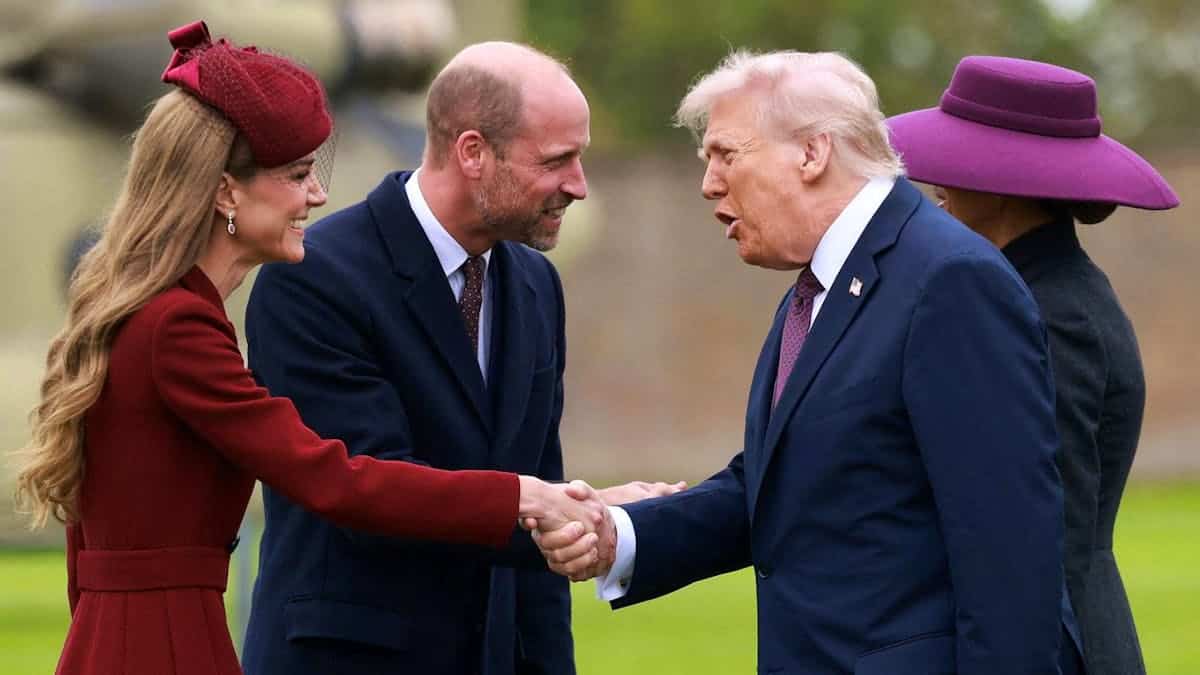
Donald Trump arrived in the middle of the day on Wednesday at Windsor Castle, received by the royal family for his second state visit to the United Kingdom, who is staying away from the public and demonstrations.
The American president and his wife Melania were greeted as they descended from the helicopter by Crown Prince William and his wife Catherine, then by King Charles III and Queen Camilla, under a gray sky.
The main street of Windsor was decorated with British and American flags for the occasion. The police are present in large numbers in this town located about forty kilometers west of London.
Surrounded by exceptional security, this two-day state visit begins with a spectacular display of royal pomp, of which the Republican leader is fond, and a military ceremony of unprecedented scale, involving 1,300 members of the British armed forces.
After a royal salute from the castle and from the Tower of London, the three couples took part in a carriage procession, but still within the grounds of the estate, and not in the streets of the city as had been the case during the state visit of French President Emmanuel Macron in July.
The visit takes place behind closed doors, without interaction with the public. Donald Trump is unpopular in the United Kingdom, and thousands of demonstrators are expected in central London to protest against his arrival. The rally calling for the “Stop Trump” coalition, starting at 2 p.m. (3 p.m. in Switzerland), will be supervised by more than 1,600 police officers.
A few dozen people made the trip to Windsor.
“It’s good that a president is coming to the United Kingdom, and we should welcome Donald Trump,” Charlene Bryan, who came from London, told AFP. But it’s “quite sad that the public can’t see (it),” regrets this 40-year-old woman who works in a nursery school.
“Very special place”
Some also came to protest against the president. “I had never participated in a demonstration in my life, but I needed to show my disagreement” with Donald Trump, explains Lynn Iliffe, a retiree from Stafford (central England). “Tyran, Racist, Misogynist”, we can read on the sign she brandishes.
“This is going to be a very big day,” commented Mr. Trump upon arriving in the United Kingdom on Tuesday evening. “Many things here warm my heart. (…) It’s a very special place,” he also said.
He has several times congratulated himself on being the only American president to have twice the honors of a state visit to the United Kingdom. The first took place in 2019.
In Windsor, the American president will have the unique privilege of reviewing a guard of honor exceptionally comprising three regiments of the Royal Guard, accompanied by a fanfare, drums and bagpipes in the square courtyard of the castle.
After a private lunch with the royal family, the Trump couple will lay flowers on the grave of Queen Elizabeth II, who died in September 2022, in St George’s Chapel.
An air parade, combining in a unique way British and American F35 combat aircraft, and the aerobatic patrol of the “Red Arrows”, will precede the traditional royal banquet with some 150 guests.
The shadow of the Epstein affair
A profusion of honors likely to flatter the ego of the American billionaire, who earlier this year compared himself to a monarch.
The second day of the visit, Thursday, will be devoted to a more political sequence, which will take place at Checkers, the country residence of Prime Minister Keir Starmer.
The press conference could give rise to embarrassing questions for the two leaders, particularly relating to the Jeffrey Epstein affair.
Keir Starmer’s government, economically weakened and in the midst of a political crisis, is seeking to take advantage of this visit to increase the number of announcements.
In particular, it has already recorded a massive investment of 30 billion $ (25 billion euros) from Microsoft.
The British pharmaceutical laboratory GSK announced an investment of $30 billion over five years in the United States, particularly in research and development.
According to the “Financial Times”, Keir Starmer has given up on obtaining an exemption from the 25% customs duties applied to British steel, although promised at the beginning of May.
