
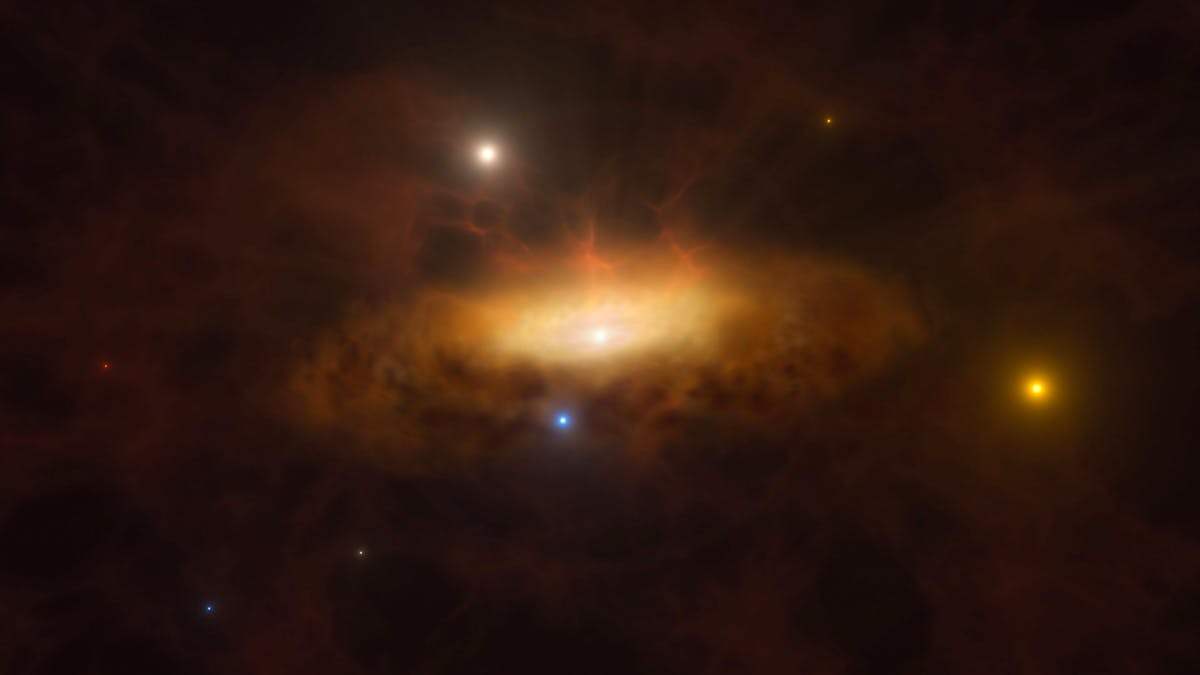
The massive black hole in the heart of a galaxy of the Virgin constellation was “awakened”, producing jets of X-ray at quasi-regulating intervals that intrigue astronomers, according to a study published on Friday.
At 300 million light years from us, the distant Galaxy SDSS1335+0728 was until recently the subject of little attention from astronomers. But at the end of 2019, she suddenly started to shine with a singular shine. And in February 2024, a team led by Lorena Hernández-García, from the University of Valparaiso (Chile), began to observe X-ray jets at almost regular intervals. A sign that his black hole was “wake up”.
Most galaxies, including the Milky Way, house a solid black hole in their center. This object is by definition invisible, because if compact that its gravity force even prevents light from escaping. When a star has the misfortune of approaching it too much, it is torn: the material that composes it dislocates, then turns very quickly around the black hole, forming an accretion disc before a part is engulfed there forever. A phenomenon called “tidal effect rupture”.
Inactivity phases
But a black hole can also experience long phases of inactivity during which it does not actively attract material and no radiation is detectable around it.
The brilliant and compact region at the heart of SDSS1335+0728 is now classified as an active galactic nucleus, nicknamed “Ansky”. “This rare event gives us the opportunity to observe the behavior of the black hole in real time, using the XMM XMM-Newton spatial telescopes (from the European Space Agency) and Nicer, Chandra and Swift of NASA”, explains Ms. Hernández-García in a press release accompanying the publication of the study in “Nature Astronomy”.
These short-term X-ray jets are known as almost perceiving eruptions (QPE) and “we do not yet understand what causes them,” said the Chilean astronomer. The current hypothesis is that the QPEs are associated with the accretion discs formed as a result of ruptures by tidal effect. But no sign of the destruction of a star in the gravitational field of the black hole was detected. And Ansky eruptions have unusual characteristics.
Eruptions ten times more lunimeous
They are “ten times longer and ten times brighter” than those of typical QPEs, details Joheen Chakraborty, team member and doctoral student at Massachusetts Institute of Technology (United States).
“Each of these eruptions releases a hundred times more energy than we have seen elsewhere. They also have the longest cadence ever observed, around 4.5 days. This pushes our models to their limits and questions our existing ideas on the generation of these X-ray jets, “he added in the press release accompanying the study.
This prompted the authors to consider other hypotheses. According to them, the accretion disc could have been formed by gas captured by the black hole in its vicinity. In this scenario, the X -ray jets would come from highly energetic shock in the disc, caused by a small celestial object crossing it several times.
“Imagine a star turning around the black hole on an orbit tilted from the disc. The star crosses the disc twice by orbit “without there being a” really important force to attract it “, explains to AFP Norbert Schartel, scientific manager of the XMM-Newton telescope.
“We are still to the point where we have more models than data on QPEs. We need other observations to understand what is going on, ”adds his colleague from ESA Erwan Quintin.
