
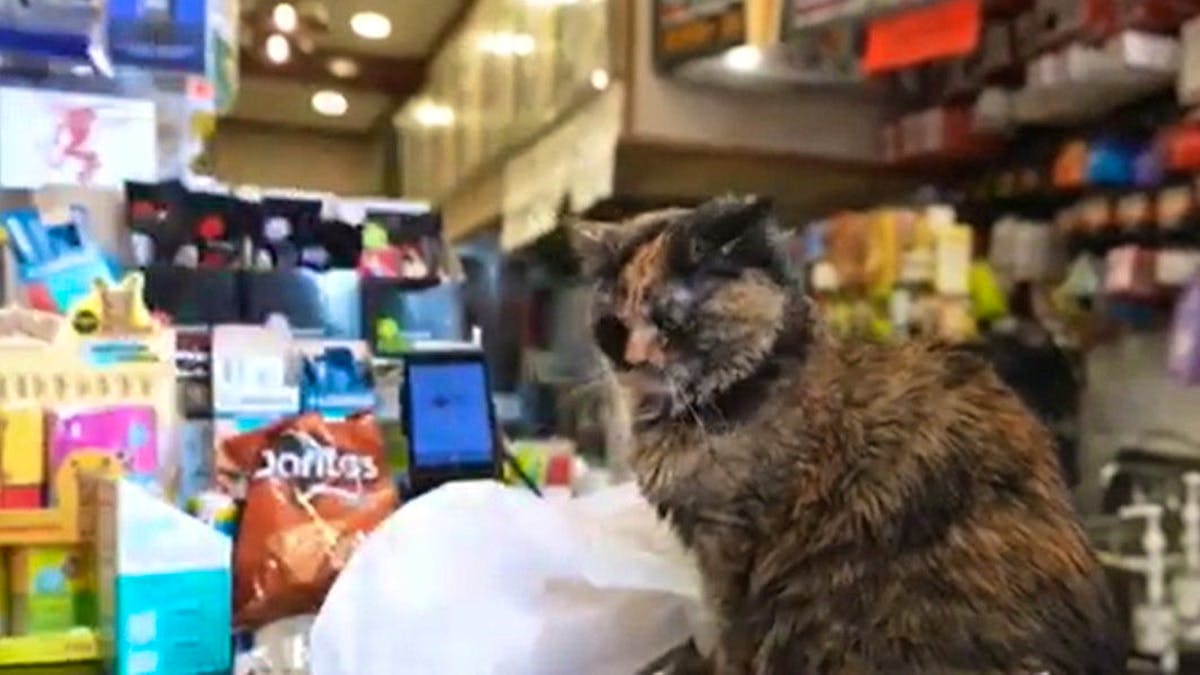
Like Simba, a large red and white cat with thick fur, thousands of felines populate New York’s grocery stores, although animals are prohibited there. Local elected officials are proposing to legalize their presence, with the aim of guaranteeing them better living conditions.
“Simba is very important to us because it prevents rodents from entering the store,” Austin Moreno, at the checkout counter at a Manhattan grocery store, told AFP.
The animal also attracts customers. “People often come in and ask what his name is. Recently, little girls saw it for the first time. Now they come every day,” adds Mr. Moreno.
The presence of animals in food businesses in New York is punishable by a fine of 200 to 350 euros. Around a third of the approximately 10,000 “bodegas” (the name given to neighborhood grocery stores) would still be inhabited by a cat, estimates Dan Rimada.
During the Covid pandemic, the 30-year-old started photographing these felines, publishing the photos on the Instagram account “Bodega Cats of New York”. “They are an integral part of the urban fabric and it’s an important story to tell,” he says.
Last year, Dan Rimada launched a petition in favor of the legalization of “bodega cats”, collecting nearly 14,000 signatures.
Free vaccines and sterilizations
Inspired by this petition, New York City Councilor Keith Powers proposed a text protecting “bodega cat” owners from sanctions.
“He also ensures that these cats receive the care they deserve by offering free vaccinations and sterilizations,” explains the elected official, in order to avoid adding to the large population of stray cats, estimated at half a million in New York.
His initiative, however, does not convince the associations.
Becky Wisdom, who takes in felines in Brooklyn, says she is “stunned” that public funds are being considered for business owners rather than low-income families wishing to have their cats sterilized.
She also regrets that this initiative does not take into account abuse. Many cats are kept locked in cellars, deprived of food, water, bedding and veterinary care, forced to breed in order to sell their young, or abandoned when they grow old and become ill.
She is also worried that such a measure will deprive her of a “means of pressure” with the bodegas: the associations point out that the presence of cats is illegal, so that the owners let them look after them.
Furthermore, whatever the city decides, it is the State of New York which has the final say on the rules applying to businesses, adds Allie Taylor, president of the animal rights association Voters for animal rights.
The latter therefore calls for the adoption of another more restrictive initiative brought before the state assembly by an elected official from Manhattan, Linda Rosenthal.
Already at the origin of laws prohibiting the declawing of cats by amputation or the sale in pet stores in order to encourage adoption, Ms. Rosenthal proposes authorizing the presence of felines in bodegas under certain conditions, from obligatory veterinary visits to “a safe place to sleep”.
