
Did the distant ancestors of mammals, who lived 250 million years ago, lay eggs or give birth to young? The analysis of a Lystrosaurus embryo finally answers the question. It’s a mystery that has preoccupied paleontologists for decades: Synapsids, the stem group from which mammals came, are thought to have been oviparous, as were, among their current descendants, platypuses and echidnas. “But we lacked formal evidence, and evidence was even beginning to accumulate to the contrary,” Julien Benoit, professor at the Institute for the Study of Evolution at the University of the Witwatersrand (South Africa), tells AFP.
Starting with the fact that in 180 years of research, no synapsid egg has ever been formally identified as such. “Here in South Africa, we found soft-shelled dinosaur eggs, so there was no reason why we couldn’t find eggs from synapsids that lived at the same time, in the same place and were much more numerous,” notes the scientist. The study, which he co-signed Thursday in “PLoS ONE”, provides the long-awaited proof thanks to a tiny fossil of Lystrosaurus, an herbivore which lived 250 million years ago. It was discovered 17 years ago in the Karoo basin (South Africa), says Jennifer Botha, another co-author of the article, in a press release from the European Synchrotron in Grenoble.
Great microscope
“My preparer, John Nyaphuli, an outstanding fossil hunter, identified a small nodule that initially revealed only tiny fragments of bone. By carefully preparing the specimen, it became clear that it was a perfectly curled up baby Lystrosaurus. I already suspected at the time that it had died in its egg, but we simply did not have the technology to confirm it,” continues the professor at the Institute for the Study of Evolution at the University of the Witwatersrand. “Anywhere else in the world, seeing a baby curled up like that, you would have said ‘it’s an egg’. But it is quite common in South Africa to find entire fossils rolled up on themselves,” explains Mr. Benoit.
Trapped in their burrows by sudden floods, the animals were buried in mud while they slept. This is where the European Synchrotron in Grenoble (ESRF) came into play, a “super microscope” which produces X-rays 10,000 billion times brighter than those used in hospitals. “We were able to scan the fossil with maximum precision and thus capture the level of detail necessary for the study of these bones which are so small and fragile,” explains Vincent Fernandez, scientist at the ESRF and co-author of the study. The scans revealed a crucial detail in the mandible of the tiny Lystrosaurus, whose entire skull measured just 4cm. This lower jaw bone is made up of two halves that must fuse together for the animal to eat.
This stocky herbivore dominated the ecosystem
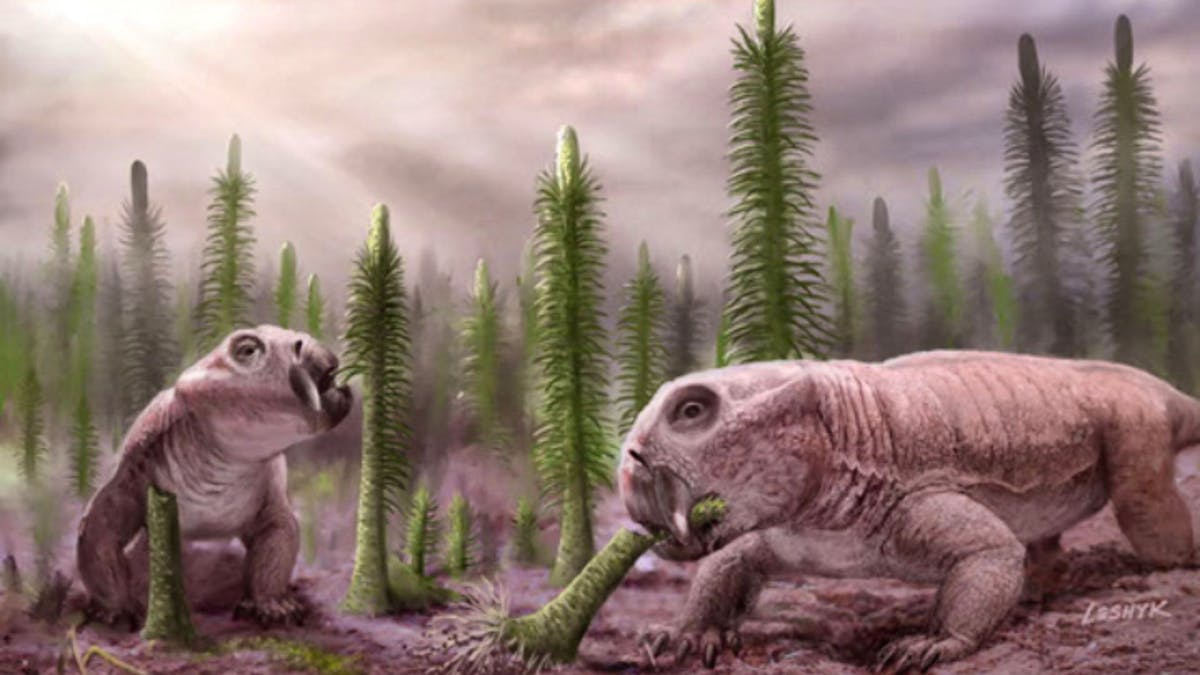
“It is normally a structure that closes well before birth. There, we realized that there was this huge hole inside which is a real anatomical structure, not just damage that would have been caused post-mortem,” describes Mr. Benoit. In current bird and turtle embryos, this stage of development is only observed before hatching, proof that it was indeed an egg. This discovery also sheds light on one of the reasons why this stocky herbivore, equipped with two short tusks, was able to dominate the ecosystem of its time after the most devastating crisis that life on Earth has known: the mass extinction of the Permian-Triassic.
As a result of brutal global warming, 95% of marine species and 70% of terrestrial vertebrates have disappeared. Yet Lystrosaurus survived and even took a dominant place in a world marked by high temperatures and prolonged droughts. One of the keys to its success could have been the size of its relatively large eggs, the authors suggest. In modern animals, larger eggs are more resistant to dehydration and contain more yolk (the egg yolk), providing all the nutrients needed for the embryo to develop.
