
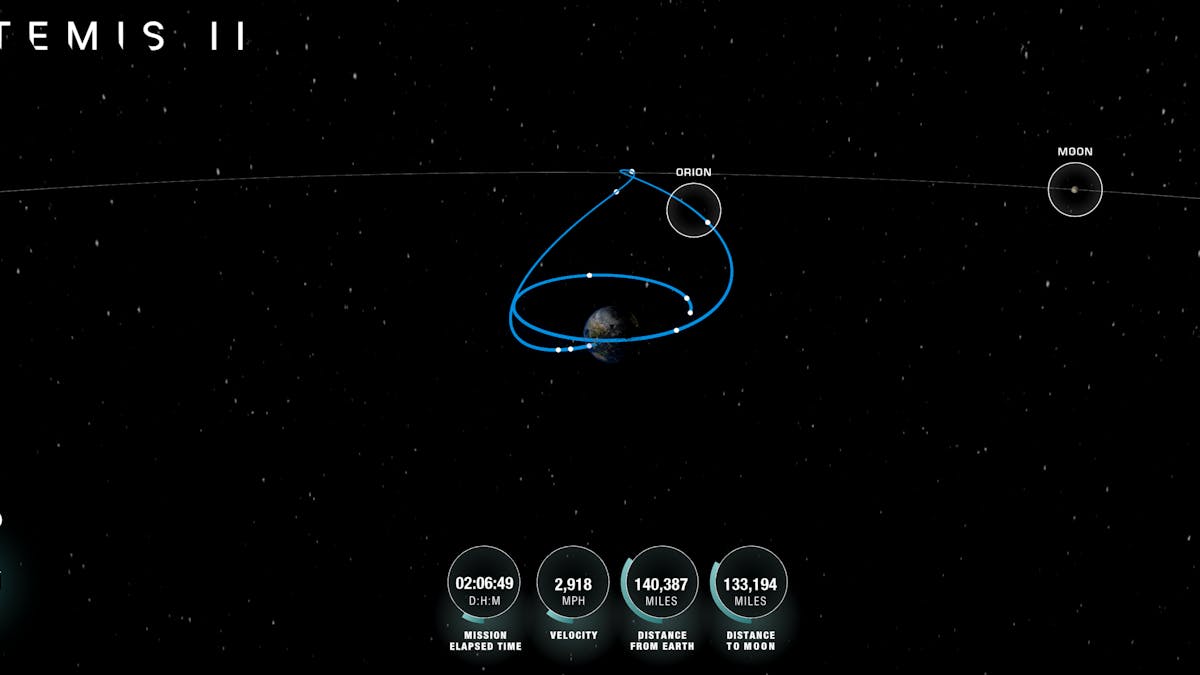
The four astronauts of NASA’s Artemis 2 mission have gone more than halfway between the Earth and the Moon and continue on Saturday to get closer to the star which they will circle at the beginning of next week, a first since 1972.
“We are halfway,” wrote NASA, tracking data from the Orion spacecraft showing it around 4:00 GMT (6 a.m. in Switzerland) more than 219,000 km from us.
Americans Christina Koch, Victor Glover and Reid Wiseman and Canadian Jeremy Hansen on board are the first human beings to venture this far into space since the end of the Apollo program more than half a century ago.
Broadcast live
An odyssey broadcast live by NASA and immortalized by the astronauts, who took smartphones and cameras with them. Their first images of the Earth, notably passing in front of the Sun, were published Friday by the American space agency.
“We see our little blue marble through the eyes of the crew, and suddenly we find ourselves up there with them,” commented a NASA official.
“Sticked to the windows”
After a successful takeoff from Florida on Wednesday, the crew made the big thrust necessary for them to exit Earth’s orbit on Thursday and headed towards the Moon. “We are all glued to the windows,” confided Jeremy Hansen on this occasion. “Nothing can prepare you for the emotion that grips you” at that moment, added his colleague Christina Koch.
For half a century, no human being had observed the Earth from so far away, human exploration having been limited since the end of the Apollo program to the immediate surroundings of the Earth, mainly the International Space Station (ISS), at an altitude of approximately 400 kilometers.
The Moon is approximately 1000 times further away and it will take astronauts several days to reach it. They will not land there, but will circle it and pass behind its hidden side on Monday before returning to Earth on April 10. During this journey, the crew, which is the first on a lunar flight to include a woman, a person of color and a non-American, will break a record by becoming the human beings to have ventured the furthest into space.
An ingenious calculation to be able to return
Their trajectory is called “free return”, that is to say designed so that the vessel is attracted by the Moon then naturally brought back to the Earth. An ingenious but restrictive calculation because it makes any return impossible, Orion having to go to the Moon before being able to return.
In the event of a major problem, the astronauts would have to put on their suits, designed to ensure their survival for six days. If NASA has sought to prepare for any eventuality, unforeseen events could arise because this is the first manned flight of the Orion spacecraft.
“It’s important to keep this in mind as we learn more every day” about the ship, Lakiesha Hawkins, a senior agency official, said on Friday. The mission nevertheless seems to be going wonderfully for the moment, reports Clayton Swope, of the Center for Strategic and International Studies (CSIS), to AFP.
“If the only problems we talk about concern Microsoft Outlook and toilets, that’s a victory,” he notes, in reference to the technical hassles of emails and plumbing reported by astronauts.
Prepare future missions to Mars
The Artemis 2 mission aims to ensure that everything is in order to allow the Americans to return to lunar soil, this time to establish a lunar base and prepare for future missions to Mars.
NASA is aiming for a moon landing in 2028, that is to say before the end of Donald Trump’s mandate and the date set by their Chinese rivals to walk on the Moon. But experts expect further postponements, with the moon landing devices still under development by the companies of billionaires Elon Musk and Jeff Bezos.
And such a project is extremely complex, Commander Reid Wiseman recalled from space. “Sending four people 400,000 kilometers away is a Herculean feat, and we are only beginning to appreciate it.”
