
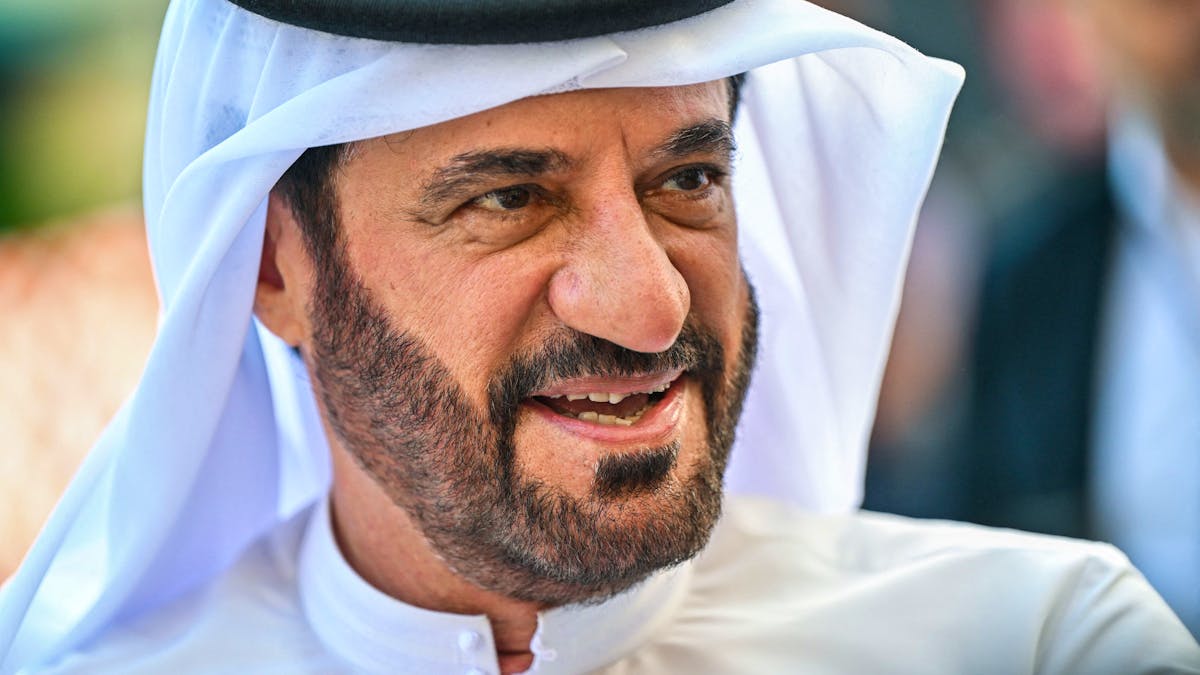
The outgoing president of the International Automobile Federation (FIA) Mohammed Ben Sulayem, at the head of the motor sport governing body since the end of 2021 and the only candidate, was unsurprisingly re-elected on Friday for a second four-year term.
“I am committed to continuing to work for the FIA, for motorsport, for mobility and for our member clubs in all regions of the world,” said the 64-year-old Emirati, 14 times winner of the Middle East Rally Championship, in a statement.
“We have overcome many obstacles, but today, together, we are stronger than ever,” he said again, after an election whose electoral process is contested.
Vaudoise Laura Villars, prevented from applying for the presidency of the FIA, took the body to court at the end of October to challenge the voting rules, which according to her prohibited any opponent of Ben Sulayem from running.
The Paris judicial court, which was seized of the case, did not suspend the holding of the election but ordered a trial to examine the electoral process which will be held from February 16, 2026.
For his first mandate, Mohammed Ben Sulayem – who succeeded the Frenchman Jean Todt – focused his campaign on the modernization of the FIA and greater transparency. It promised an external audit on governance, an assessment of finances and the establishment of budgetary and financial reports.
Under his era, the body which regulates, among other things, the Formula 1, rally (WRC) and endurance (WEC) World Championships went from a deficit of 24 million euros in 2021 to a profit of 4.7 million in 2024.
His mandate, however, was marked by several controversies: Ben Sulayem was accused of trying to influence the Grands Prix of Las Vegas and Saudi Arabia in 2023, before being cleared by the FIA Ethics Committee.
He also angered F1 and rally drivers after imposing heavy fines for foul language, a measure he eventually relaxed.
The Emirati divides even within its own camp since last April, Robert Reid, its vice-president in charge of sport and close ally, resigned denouncing a lack of transparency.
