
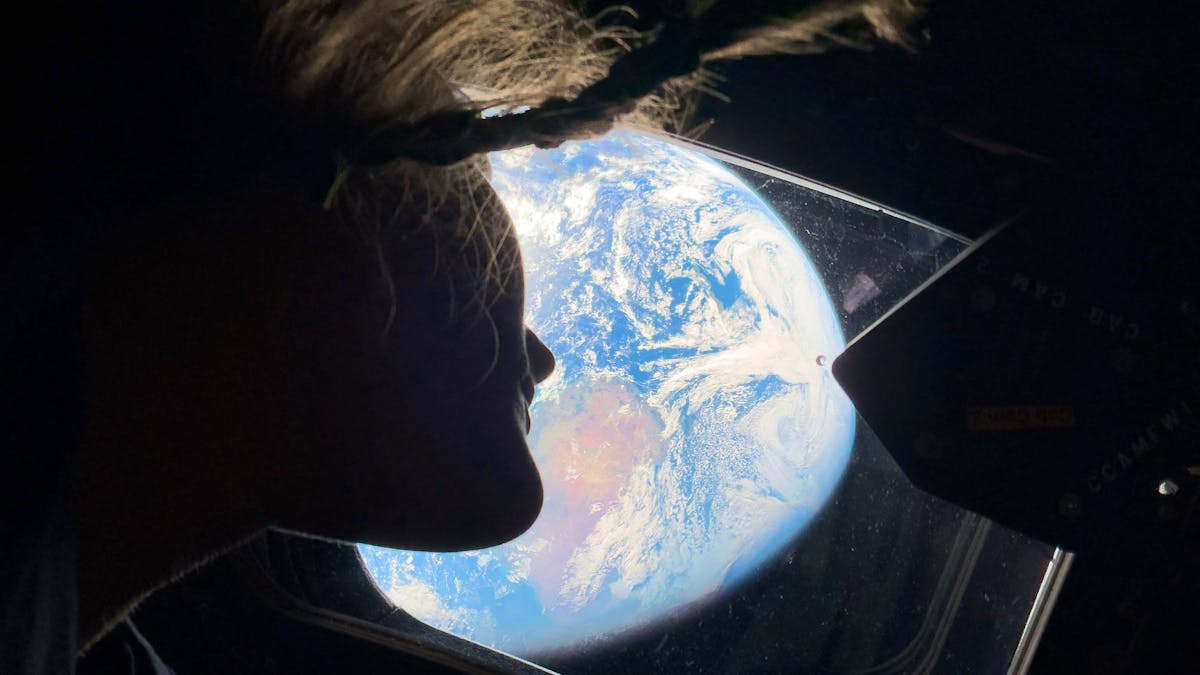
Now closer to the Moon than to the Earth, the astronauts of NASA’s Artemis II mission are busy on Saturday finalizing preparations for their long-awaited flyby of the star, scheduled for Monday. “Morale is high,” Commander Reid Wiseman told the Houston-based control center shortly after they woke up.
Now more than 280,000 kilometers from Earth, the three Americans Christina Koch, Victor Glover and Reid Wiseman, and their Canadian colleague Jeremy Hansen, continue to approach the Moon at high speed.
After passing the halfway point around 4 a.m. GMT on Saturday, they should arrive around 4:30 a.m. GMT on Monday in the “lunar sphere of influence”, that is to say at the place where the gravitational attraction of the star will take over that of the Earth.
The latter will allow them to pass on Monday behind the far side of the Moon, which has so far only been observed by a handful of men from the Apollo program.
A suspended moment which will constitute the climax of this risky mission, the first to send human beings this far into space since the end of the Apollo program more than half a century ago.
This odyssey is broadcast live by NASA and the quartet of adventurers even gives interviews from their ship.
From Earth, Internet users can thus follow their daily lives, often not so far from ours, between email and toilet problems, sports sessions, waking up to music and shared meals like their Saturday breakfast: scrambled eggs and coffee.
Ingenious calculation
After a successful takeoff from Florida on Wednesday, the crew set off on Thursday towards the Moon after a series of conclusive checks of their spacecraft – which had not previously carried anyone.
Being located approximately 400,000 km from Earth, the Moon is approximately 1000 times further than the International Space Station (ISS) and it therefore takes several days to reach it. The crew will not land there but will circle it before returning to Earth.
Their journey is “impressive from a technical point of view” because their ship must complete this loop with virtually no ignition of the engines, reports Derek Buzasi, professor of astronomy and astrophysics at the University of Chicago, to AFP.
“It’s almost like taking a ball, throwing it at the Moon and it goes around without any noticeable correction to its orbit and comes back to Earth,” he explains.
An ingenious calculation which nevertheless has a downside: no U-turn is possible. In the event of a major problem, the astronauts would have to put on their suits, designed to ensure their survival for six days.
If NASA has sought to prepare for any eventuality, unforeseen events could arise because this is the first manned flight of the Orion spacecraft. “It is important to keep this in mind as we learn a little more every day” about the ship, Lakiesha Hawkins, a senior official at the agency, said on Friday.
Future missions to Mars
The mission nevertheless seems to be going wonderfully for the moment, reports Clayton Swope, of the Center for Strategic and International Studies (CSIS), to AFP.
“If the only problems we talk about concern Microsoft Outlook and toilets, that’s a victory,” he notes, in reference to the technical hassles of emails and plumbing reported by astronauts.
The Artemis II mission aims to ensure that everything is in order to allow the Americans to return to lunar soil, this time to establish a lunar base and prepare for future missions to Mars.
NASA is aiming for a moon landing in 2028, that is to say before the end of Donald Trump’s mandate and the date set by their Chinese rivals to walk on the Moon.
But experts expect further postponements, with the moon landing devices still under development by the companies of billionaires Elon Musk and Jeff Bezos.
