
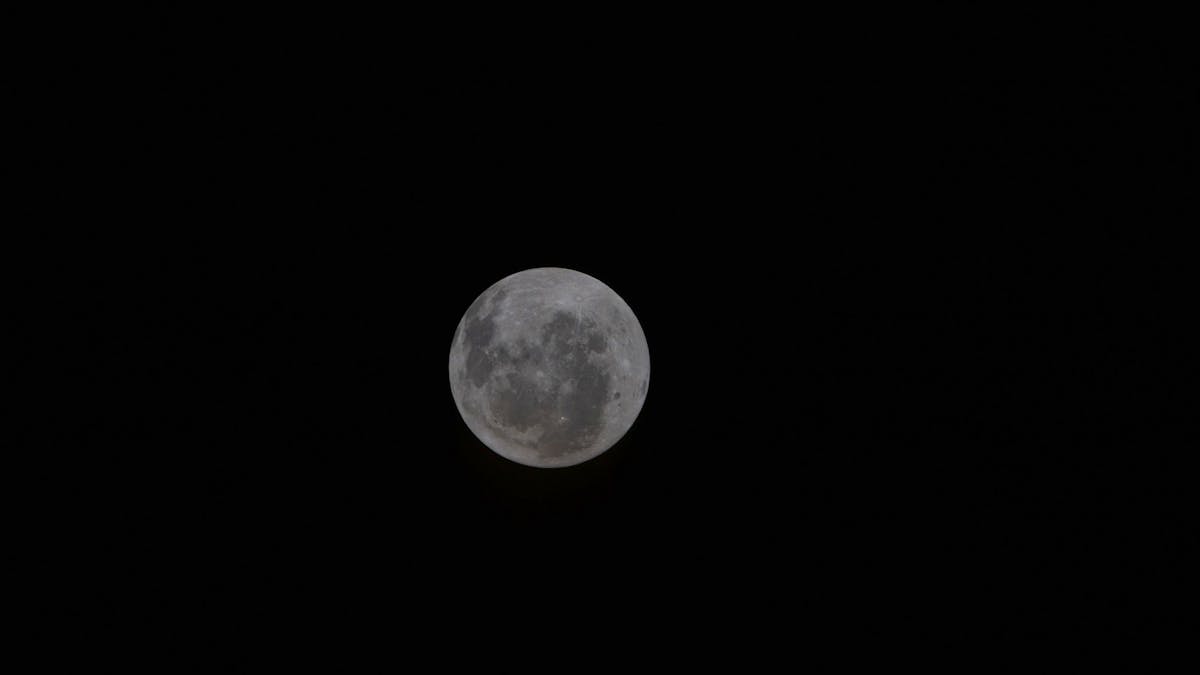
The astronauts of NASA’s Artemis 2 mission continue to get closer to the Moon on Sunday, of which they were able to glimpse portions never directly observed by humans before.
Awakened by music, according to the long tradition of the American space agency, the three Americans and a Canadian then had the pleasure of receiving a message from one of their most famous predecessors.
“Thank you and the entire ground crew for continuing Apollo’s legacy with Artemis. Have a safe trip and return,” wished them Apollo astronaut Charles Duke, now 90 years old. The American is one of the last men to have ventured to the star, in 1972. Since then, no human being has come close.
After a successful takeoff from Florida on Wednesday, the crew is now heading at full speed towards the Moon about 400,000 km from Earth, or 1000 times further than the International Space Station (ISS), and should arrive in its vicinity on Monday, a first in more than half a century.
On the way, he has already been able to glimpse portions of the hidden side of the Moon, the hemisphere permanently on the side opposite the Earth, which had until now never been observed directly by the human eye.
“Grand Canyon of the Moon”
Among them, the Orientale basin “sometimes nicknamed the Grand Canyon of the Moon”, enthused astronaut Christina Koch on board. “No human eye had truly seen this crater until today, when we had the privilege of seeing it.”
With her American colleagues Victor Glover and Reid Wiseman and the Canadian Jeremy Hansen, she will not land on the Moon but will pass behind its hidden side on Monday before leaving for Earth, for a return scheduled for April 10.
During its flyby of the Moon, the climax of this mission, which will be broadcast live with the exception of an expected 40-minute cut, the quartet of adventurers should make valuable observations with the naked eye.
All have been trained for more than two years to study and describe geological formations, and their notes and photographs should help us learn more about the geology and history of our natural satellite.
If the Apollo pioneers had passed at an altitude of 110 kilometers, Artemis 2 will remain much further away, around 6,500 kilometers from the ground due to its trajectory. Because of this distance, astronauts will benefit from a view of the full disk of the moon, including the pole region.
“Most beautiful moment”
Between live YouTube, photos taken on the iPhone and television interviews granted from space, NASA seeks to take the public on this new lunar odyssey.
The world was thus able to remotely follow the email and toilet problems encountered by the astronauts as well as their sports sessions and shared meals.
The objective on the NASA side is to ensure that everything is in order to allow the Americans to return to lunar soil in the coming years in order to establish a lunar base and prepare future missions to Mars.
During the Moon flyby, “we are going to learn a lot about the spacecraft,” NASA boss Jared Isaacman said on CNN on Sunday. “This is what interests us most in terms of data,” he continued, recalling that the Orion capsule in question had not previously carried any human being.
NASA is aiming for a moon landing in 2028, that is to say before the end of Donald Trump’s mandate and the date set by their Chinese rivals to walk on the Moon.
But experts expect further postponements, as the moon landing devices developed by the companies of billionaires Elon Musk and Jeff Bezos are still not ready.
