
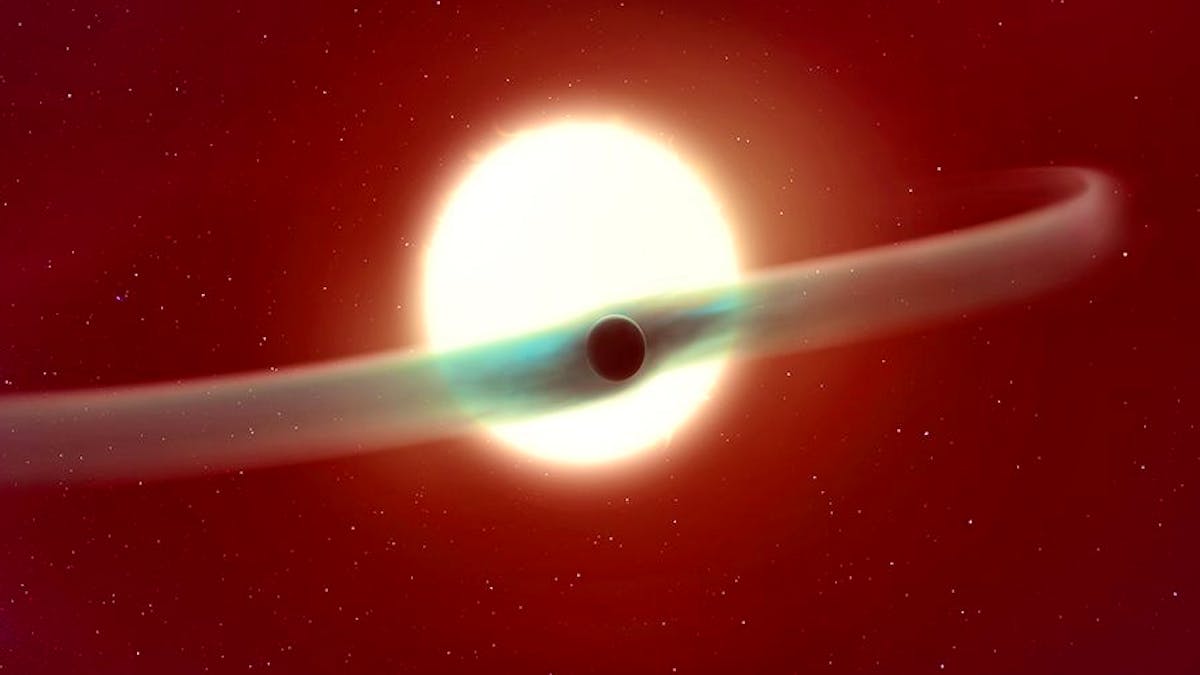
Part of the family of ultra-hot Jupiters, WASP-121b is an immense gaseous planet that orbits so close to its star that its revolution lasts only 30 hours. The star’s intense radiation heats its atmosphere to several thousand degrees, allowing light gases like hydrogen and helium to escape into space. Over millions of years, this slow atmospheric escape can change the size, composition and future evolution of the planet.
Until now, scientists had only obtained brief glimpses of these atmospheric flows during planetary transits, those few hours when the planet passes in front of its star. Without continuous monitoring, it was impossible to know how far these flows extended or how they were changing.
Using the near-infrared spectrograph (NIRISS) of the James Webb Space Telescope (JWST), astronomers from the University of Geneva (UNIGE), the National Research Center PlanetS and the Trottier Institute for Research on Exoplanets (IREx) of the University of Montreal (UdeM), observed WASP-121b for nearly 37 consecutive hours, covering more than a full orbit. This is the most complete continuous observation ever made of the presence of helium on a planet.
Two leaks of more than 100 diameters from the planet
By tracking the absorption of helium atoms in infrared light, scientists discovered that the gas surrounding WASP-121b extends far beyond the planet itself. The signal persists for more than half the orbit, constituting the longest continuous detection of atmospheric escape ever observed.
Even more remarkable: the helium particles form two distinct tails. A trailing tail, pushed back by radiation and stellar wind, and a leading tail, curved in front of the planet, probably drawn towards the star by its gravity. Together, these two “flows” cover a distance equivalent to more than 100 times the diameter of the planet, or more than three times the distance separating the planet from its star.
“We were incredibly surprised to see how much helium escape persisted,” explains Romain Allart, postdoctoral researcher at the University of Montreal, former doctoral student at the University of Geneva (UNIGE) and lead author of the article published in “Nature Communications”. “This discovery reveals the complexity of the physical processes that sculpt exoplanetary atmospheres and their interaction with their stellar environment. We are only beginning to discover the true complexity of these worlds.”
The Department of Astronomy at UNIGE is at the forefront of the study of atmospheric escape. The numerical models developed there have, for example, made it possible to understand the first observations of helium with the JWST. These models can explain simple, comet-shaped tails, but here they struggle to reproduce the double structure observed on WASP-121b.
“This discovery indicates that the structure of these flows results from both gravity and stellar winds, which makes a new generation of 3D simulations essential to analyze their physics,” indicates Yann Carteret, doctoral student in the Department of Astronomy of the Faculty of Sciences of UNIGE and co-author of the study.
Single or common structure?
Helium has become one of the most powerful tracers of atmospheric exhaust, and the unique sensitivity of JWST now makes it possible to detect it over distances and durations never before achieved. Future observations of JWST will be essential to determine whether the double-tailed structure observed around WASP-121b is unique or common among hot exoplanets. Scientists must also refine their theories to better understand this structure.
“Very often, new observations show the limits of our digital models, and push us to explore new physical mechanisms to push our understanding of these distant worlds ever further,” concludes Vincent Bourrier, lecturer and researcher in the Department of Astronomy of the Faculty of Sciences of UNIGE and co-author of the study.
