
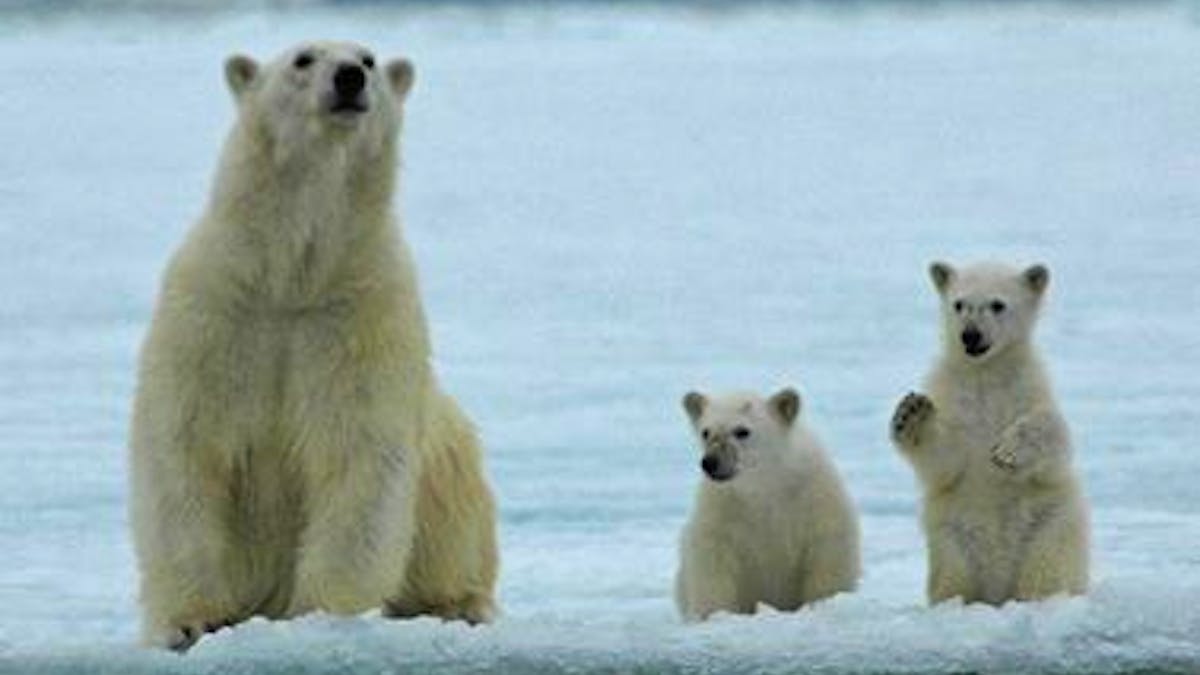
Researchers in Canada recently observed a very rare case of a polar bear adopting a cub that was not hers, in the north of the country.
“Only 13 cases of adoption have been recorded in 45 years,” Evan Richardson, a researcher at the Canadian Ministry of the Environment, who has been studying the Arctic’s largest predator for 25 years, explained to AFP.
In November, he and his team captured a female bear and her two cubs, aged 10 and 11 months, near Churchill, nicknamed the “polar bear capital of the world”, located in the northern province of Manitoba. “When we approached, we noticed that one of the cubs had an identification tag, and the other did not,” he said, adding that this same female had been seen a few months earlier with a single cub.
In this northern region, researchers identify polar bears so they can follow them throughout their lives and study them. GPS collar tracking and observations from Polar Bears International, a polar bear research group, confirmed that the female in question had kept the two cubs with her for several weeks.
“It’s a great story,” rejoiced Evan Richardson. “These polar bears are excellent mothers, they are naturally predisposed to caring for their cubs.”
The biological mother sought
The subpopulation of polar bears in western Hudson Bay has fallen by 30% in a few decades, from around 1,200 individuals in the 1980s to 800 today, due in particular to the accelerated melting of ice, essential to their survival. However, there is no evidence to link this adoption to climate change, according to Mr. Richardson.
Genetic analyzes are underway to identify the biological mother of the adopted bear cub. “There’s a good chance we know who she is,” the scientist said.
Over the past 45 years, more than 4,600 bears have been identified in this region of Canada, making it, according to him, “the best-studied population of polar bears in the world.”
