
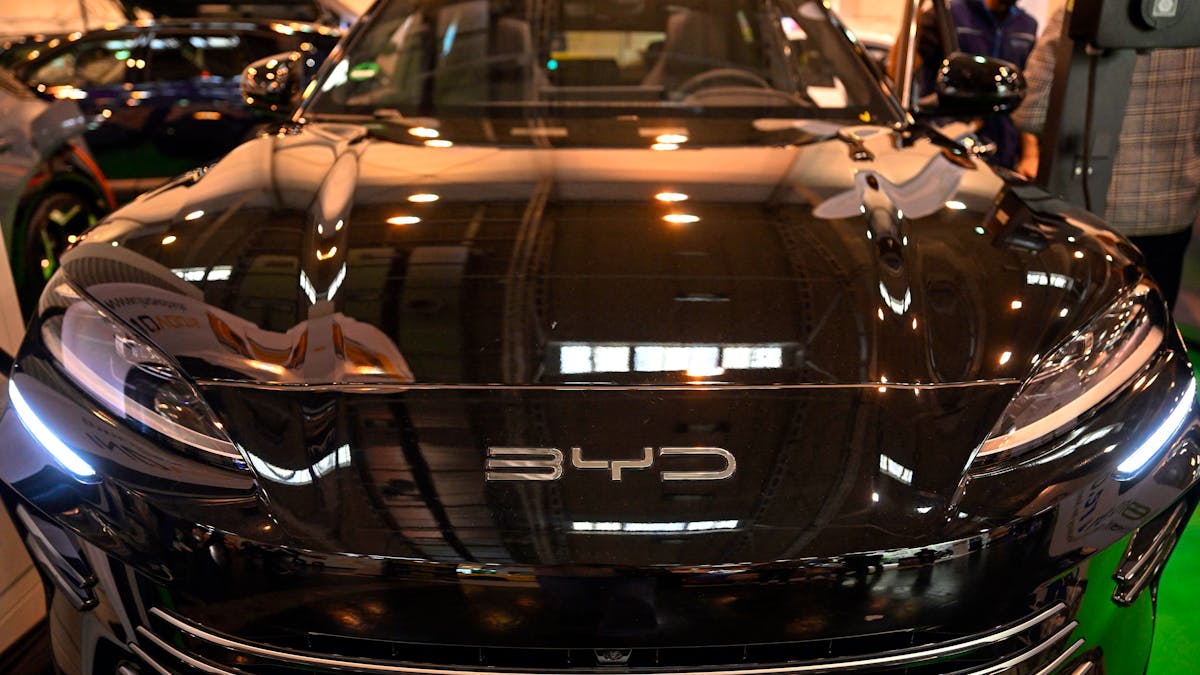
BYD’s rapid global expansion, combined with the difficult regulatory and political environment for Tesla in the United States and elsewhere, will allow the Chinese manufacturer to claim pole position for all-electric vehicle sales for the first time in 2025.
Both groups are due to publish their annual sales soon, but based on their latest publications, BYD has taken such a lead that it seems almost impossible that Tesla could have closed the gap.
At the end of November, the Shenzhen group – which also manufactures hybrids – had sold 2,066,002 fully electric vehicles, becoming the first to cross this threshold. For its part, Tesla had 1,217,902 vehicles at the end of September.
The American group benefited in the third quarter from a boost linked to the end of a tax credit in the United States, encouraging many buyers to anticipate their acquisition. Its global deliveries jumped 7% year-on-year (497,099 vehicles). But experts quickly predicted a contraction in the following quarter. The consensus of FactSet analysts is 449,000 in the fourth quarter (-9.48% year-on-year), and 1.65 million for 2025 (-7.66%).
An annual forecast well below the actual level of BYD as of November 30. The gap could even be wider since Deutsche Bank analysts expect 405,000 Tesla vehicles delivered in the fourth quarter and those at UBS anticipate 415,000 vehicles. Forecasts lowered recently.
Deutsche Bank highlighted weaker than expected sales in North America (-33%), Europe (-34%) and, to a lesser extent, in China (-10%).
TD Cowen shows more optimism (429,000 vehicles), but the quarter was “a little tricky”, with the expiration of the tax credit, which complicates the models, notes analyst Itay Michaeli, at AFP.
“Tesla’s deliveries will show signs of weakness in the fourth quarter,” Dan Ives, director at Wedbush Securities, told AFP.
“A total of 420,000 (vehicles) should be a sufficient figure to illustrate the stability of demand while the markets are focused on the launch of autonomy in 2026,” he continued.
Trump and Musk didn’t help
Sales of the Austin (Texas) group have also suffered from an unexpected slowness in the electricity transition, growing competition, but also decisions by President Donald Trump, a climate skeptic, since his return to the White House in January.
Without forgetting the proximity of Elon Musk, boss of Tesla, with Trump, during the campaign and after his inauguration, which tarnished the image of the brand and provoked demonstrations, damage and calls for boycott. Sales have plunged, and continue to plunge, particularly in Europe.
At the same time, its main Chinese rival maintained its meteoric trajectory, even if profitability on its lands suffered from consumer caution. For this reason, it is actively establishing itself internationally.
BYD “is one of the pioneers in setting up production and supply capacities for electric vehicles overseas,” Jing Yang, director for Asia-Pacific at Fitch Ratings, told AFP. And “this geographic diversification will probably help it navigate an increasingly complicated environment in terms of customs duties,” she added.
The US president has introduced customs duties on imports from around the world, with higher levels for Chinese products, going up to almost 150% for electric vehicles (EV).
A sector highly subsidized by Beijing
Competitors of Chinese manufacturers regularly denounce a sector that is highly subsidized by Beijing, allowing them to lower their prices and capture market share.
For Mr. Michaeli, the year 2026 for EV will be the year of autonomous driving (FSD) and Tesla’s future will depend on its ability to successfully make this shift. Its sales should reach 1.98 million, estimates TD Cowen. But the consensus reaches 1.86 million.
“If they succeed (the FSD), it will boost demand for their vehicles,” underlines Mr. Michaeli, also expecting the launch of new products (Semi semi-trailer, a potential SUV version of the Cybertruck pick-up).
The Cybercab, for its robotaxi service being deployed in Austin, is due to enter production in April, and the marketing of cheaper versions of the Model 3 and Y – announced in early October – should also boost sales.
