
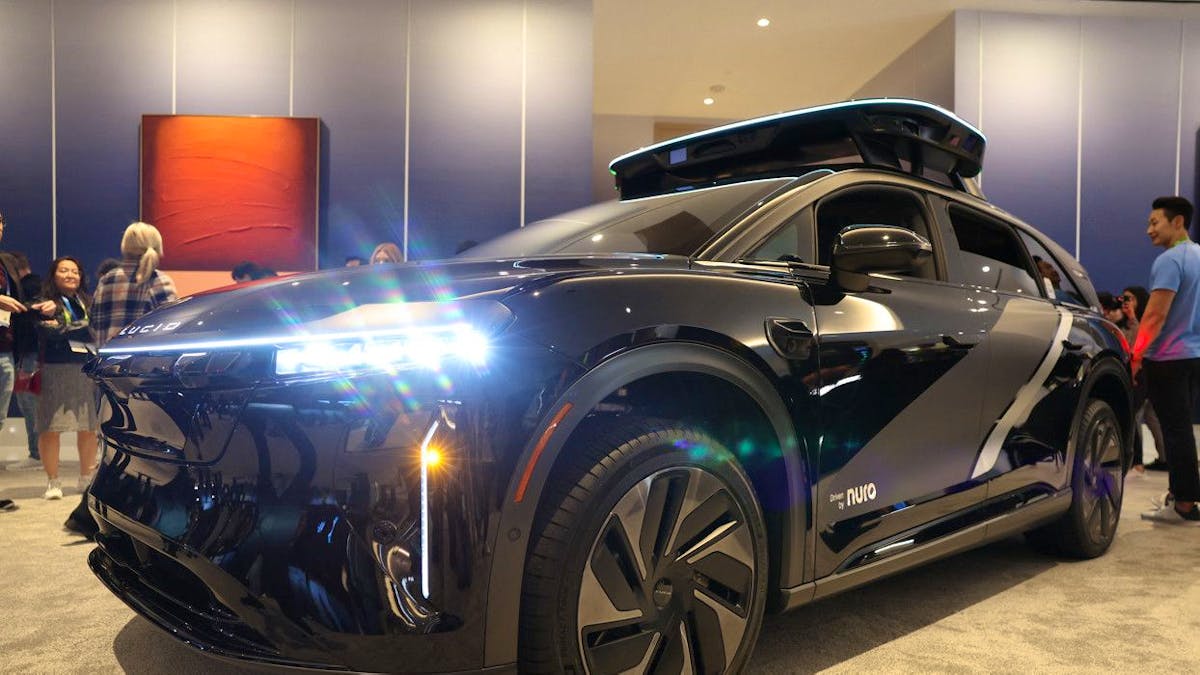
Uber and luxury electric manufacturer Lucid unveiled their future robotaxi in Las Vegas on Monday, intended to compete this year with Waymo, the world leader in driverless cars, in its own backyard in San Francisco.
This six-seater all-electric vehicle, compared to four for Waymo’s Jaguars, is a modified version of Lucid’s “Gravity” SUV, equipped with a battery of sensors (cameras, radars, lidar and ultrasound), all controlled by software from the start-up Nuro with chips from the giant Nvidia.
This prototype, unveiled at the Fontainebleau hotel-casino on the eve of the CES technology show in Las Vegas, is a step in the Nvidia and Uber project announced this fall: deploying 100,000 robotaxis from 2027, in collaboration with several different manufacturers.
The partners confirmed that they began autonomous driving tests in the San Francisco Bay Area in December. Supervised by a human on board, these tests precede the commercial launch, still planned “later in 2026”, subject to approval from the Californian regulator.
2,000 Waymo cars in five cities
The interior is intended to be reassuring for the general public: screens allow you to view in real time the environment captured by the computer (pedestrians, lights, traffic), to order stops and to adjust the music or the temperature, including the seat.
The vehicle is equipped with a roof module called “Halo”, integrating part of the sensors and intended to communicate with pedestrians, via LEDs displaying the customer’s initials, just like the small dome on the roof of the Waymo.
This deployment would mark the return of head-on competition for Waymo (a subsidiary of Alphabet), which currently enjoys a virtual monopoly on robotaxis in San Francisco since the withdrawal of Cruise at the end of 2023.
Waymo, which operates some 2,000 driverless cars in five cities in the United States, has made San Francisco its showcase, and plans to operate in around ten American cities by the end of the year.
Nearly half of its fleet constantly roams the hills near the Golden Gate, where it has become a real tourist attraction.
An Amazon subsidiary, Zoox, has opened limited public access to its driverless, steering-wheel-free vehicles in San Francisco. Tesla’s robotaxis are also present in small numbers, but still with a driver monitoring autonomous driving.
Uber already allows you to book rides without a driver, but only by acting as an intermediary for its competitor Waymo in two cities, Austin (Texas) and Atlanta (Georgia). Or on behalf of the Chinese WeRide in Saudi Arabia since October.
Chinese giant Baidu has announced robotaxis projects in the United Kingdom and Germany for 2026, with Uber competitor Lyft.
