
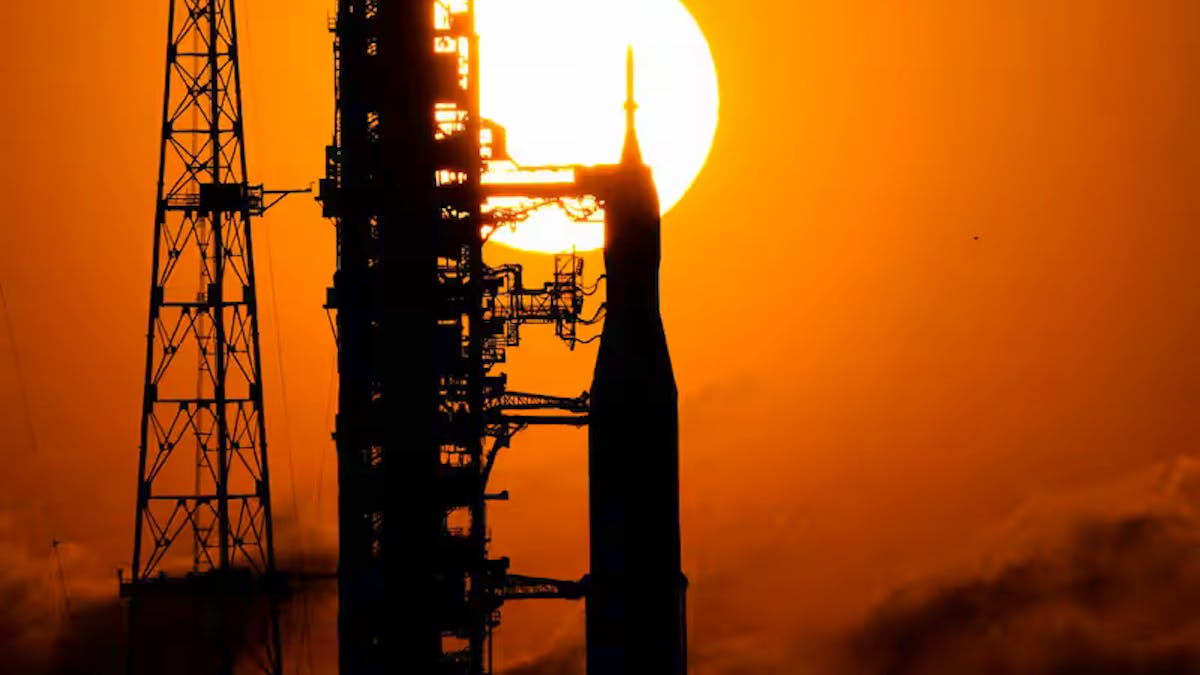
More than 50 years after the end of the Apollo program and the last manned flight to the Moon, three men and a woman embark on Wednesday for a 10-day lunar epic intended to inaugurate a new page in the American conquest of space.
This NASA mission called Artemis 2 is due to take off from the legendary Kennedy Space Center in Florida from 6:24 p.m. local time (12:24 a.m. here) with Americans Reid Wiseman, Victor Glover and Christina Koch and Canadian Jeremy Hansen on board.
“We’re really looking forward to it, we’ve never seen anything like this,” exclaimed to AFP Melinda Schuerfranz, an American retiree planning to follow their big departure from a nearby beach.
This enthusiasm for a program that cost tens of billions of $ and was years late contrasts with the indifference – until now – of many Americans to the repetition of a technological feat already achieved during the Cold War.
For approximately ten days, the four astronauts will venture to the Earth’s natural satellite to circle it without landing, like Apollo 8 in 1968. If all goes well, they will set a record by moving further from the Earth than any human being before them.
A following copy of the immense white and orange rocket, 98 meters high and non-reusable, will carry astronauts this time to the lunar surface by 2028, before the end of Donald Trump’s mandate. With in the following years a lunar base project, a step before going to explore Mars.
“We very much hope that this mission marks the beginning of an era where everyone (…) will be able to look at the Moon and consider it as a destination in its own right,” insisted Christina Koch, who will be the first woman to participate in a lunar flight.
Challenge
His companions Victor Glover and Jeremy Hansen will become the first black man and the first non-American to travel to the star.
Named in honor of the twin goddess of Apollo (Apollo in English), this mission will take place under implicit pressure from China, which aims to walk on the Moon by 2030.
Between geopolitical, strategic and scientific issues, the reasons for returning to the Moon are numerous, Canadian astronaut Joshua Kutryk insists to AFP.
But it also shows “that we are still capable of taking on this kind of challenge, of accomplishing really difficult things,” he emphasizes.
The adventure will indeed be risky, the ship has never transported anyone and must reach the Moon, more than 384,000 kilometers from Earth – a thousand times further than the International Space Station.
“Everyone will have to ensure that their job is done to perfection,” otherwise the consequences could be fatal, insists Peggy Whitson, former chief astronaut of NASA.
Miracle
In the event of a last-minute technical glitch or non-optimal weather conditions, which is not uncommon in Florida, the launch may be postponed in the coming days.
The American space agency is betting big. Its goal of returning to the Moon in 2028 has experts doubting it because the astronauts will need a lander… which is still under development by the companies of billionaires Elon Musk and Jeff Bezos.
In the meantime, NASA hopes to succeed in reproducing the miracle of Apollo 8, which offered a rare moment of communion and hope on Christmas Eve 1968 after a year marked by racial riots, the Vietnam War and the assassinations of Robert F. Kennedy and Martin Luther King. A billion people followed the journey of Frank Borman, Jim Lovell and Bill Anders on their crackling television sets.
The latter, who had immortalized the famous “Earthrise”, had “saved 1968”, in the words of an American woman at the time. Fifty-eight years later, and while the country is going through a new period of fractures and uncertainties, the crew of Artemis 2 will in turn seek to inspire.
“I guarantee you, this year, you will see more children dressed as astronauts for Halloween than you have seen in a long time,” promised the head of NASA appointed by Donald Trump, Jared Isaacman, last week.
