
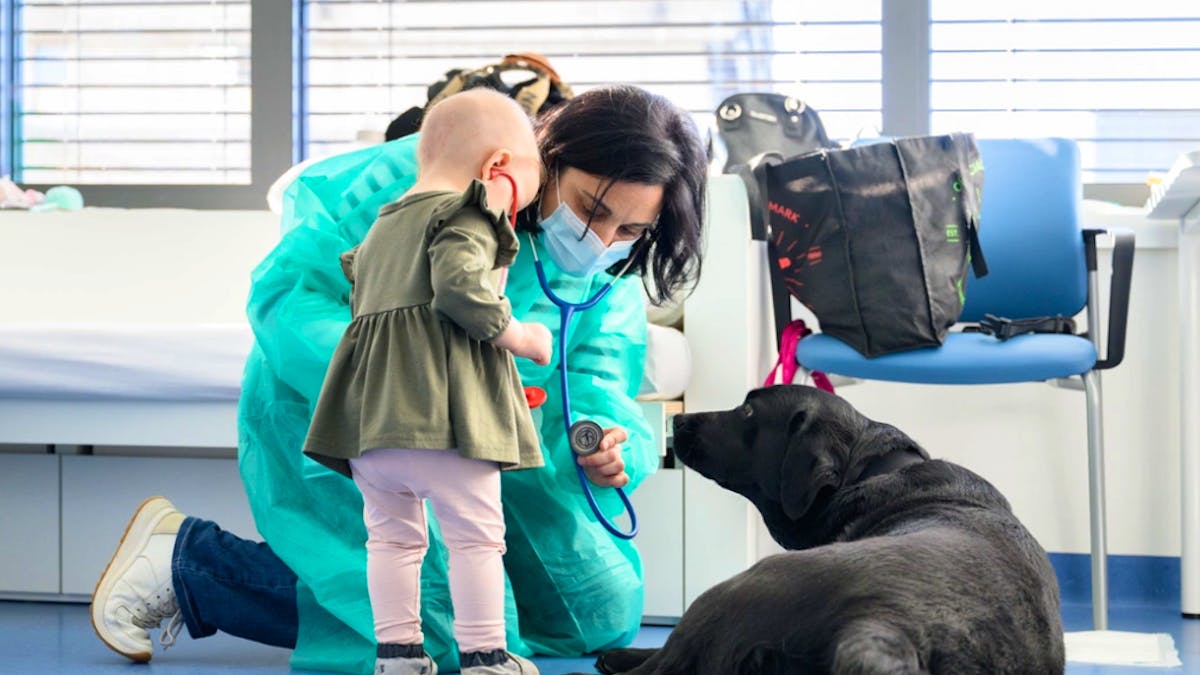
Two therapy dogs are now part of the daily lives of children hospitalized in the Pediatric Hematology-Oncology Unit at the CHUV Children’s Hospital. This unprecedented pilot project in Switzerland marks a major step forward in the integration of complementary therapies for the well-being of young patients, it was announced this Monday.
Animal-assisted therapy has been possible within the CHUV since the end of 2024 thanks to a practical procedure developed by the Center for Integrative and Complementary Medicine which facilitates the development of such treatment in the hospital’s departments. The first projects were successfully carried out in the University Neurorehabilitation Service, then within the Department of Psychiatry.
The CHUV Pediatric Hematology-Oncology Unit cares for children and adolescents aged 0 to 18 with cancers (of the blood, lymph nodes, brain or other organs) as well as non-cancerous blood diseases. Located within the Children’s Hospital, this unit brings together outpatient and hospital activity in one place and has 12 hospitalization beds.
Two dog visits per week
At the instigation of the healthcare teams and in partnership with the Center for Integrative and Complementary Medicine, this unit arranged for the arrival of two “dog-eurs”. Twice a week in turns, the dogs Cookie, an English Cocker Spaniel and Jack Russell Terrier mix, and Mary, a black Labrador, visit hospitalized children in the room. The dogs are accompanied by their therapist handlers, respectively Sibylla Protze, pediatric nurse, and Dr. Laurence Gani Janssen, child psychiatrist-psychotherapist.
Therapeutic sessions are carried out with the prior agreement of young patients and their parents and under the supervision of the medical and nursing team who select the children likely to benefit the most from these interventions. Contraindications such as allergies, a high risk of infection or a marked fear of animals are obviously respected.
Animal welfare is also considered. In fact, the handler therapists carefully monitor the number of hours worked with their dog: 2.5 hours on site and maximum 2 patients per day. Knowing their animal by heart, they can also interpret the slightest sign of stress or fatigue from the dog, who has a suitable room in which to rest between therapeutic sessions.
First in Switzerland
For this first in Switzerland in an oncology unit, a rigorous protocol was put in place including a precise list of indications and contraindications in order to guarantee the safety and benefits of the therapy, including for vulnerable patients. The dogs were evaluated and demonstrated behavior and ability to intervene in this specific hospital environment.
“We follow very specific recommendations validated by experts in animal-assisted therapy in children,” says Professor Raffaele Renella, chief physician in charge of the Pediatric Hematology-Oncology Unit. The goal is for therapy to be safe, beneficial and experienced positively by the child. Numerous scientific studies demonstrate the usefulness of animal-assisted therapy in pediatric oncology. The presence of the therapy dog can provide comfort, reduce stress or pain, contribute to motivation for treatment or even help children express difficult emotions. All this can contribute to better coping with complicated moments such as treatments or hospitalization.”
The main objective is to promote the physical, relational and emotional well-being of children and adolescents, to alleviate certain symptoms and to improve the care experience by strengthening motivation and participation in treatments.
Barbara Tarditi, head of the educational service and pediatric offerings for children at CHUV, explains: “Animal-assisted therapy is a valuable and innovative component of pediatric care. This project is fully in line with the CHUV’s desire to expand services intended for young patients by adopting a holistic approach to care that considers the treatment of the illness and the overall well-being of the child. This complementary approach improves their daily quality of life and positively supports the therapeutic journey.”
Encouraging beginnings
After four months of implementation, the feedback is very positive. The dogs and the handler therapists have fully integrated into the unit team and their presence generates very encouraging effects: children who have been bedridden for several weeks suddenly agree to get up, for example, and discussions have been facilitated around difficult subjects such as the end of life. Teams also note that valuable emotional support was provided during trying times.
The Zoé4life association, a French-speaking association which supports the fight against childhood and adolescent cancer, is financing the first six months of the project and is currently seeking additional funding to ensure its continuity. Ultimately, the CHUV Women-Mother-Child Department hopes to extend animal-assisted therapy to other pediatric units.
