
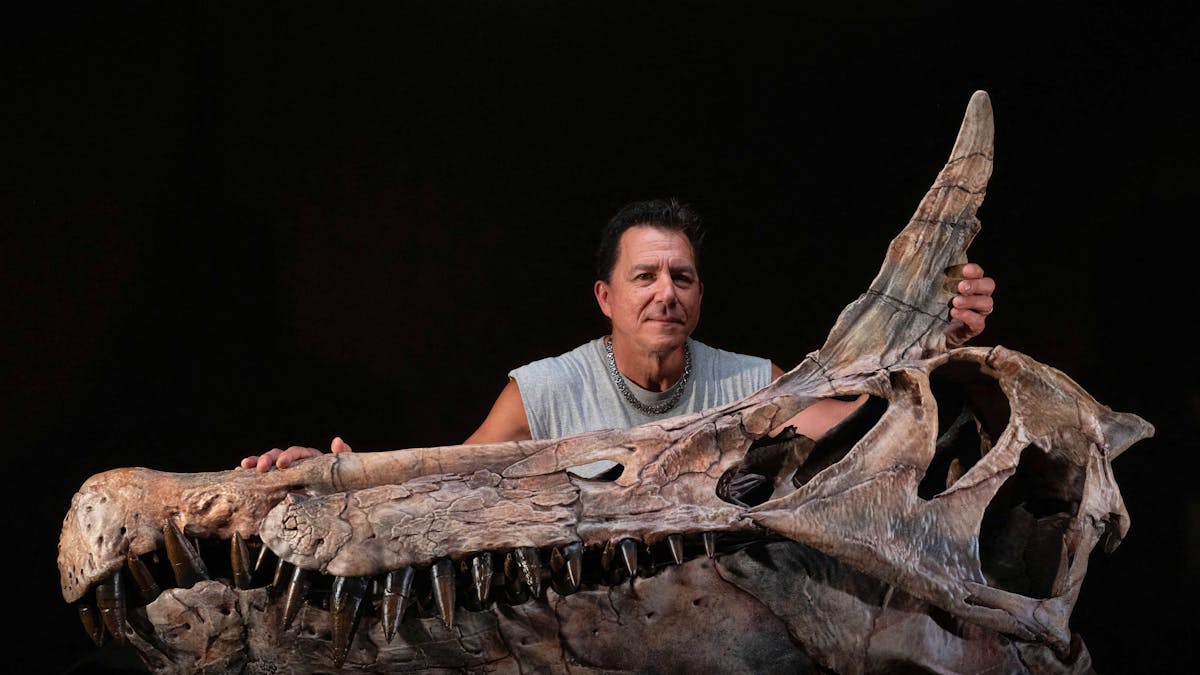
At the end of a real expedition into the Nigerien desert, part of a line from a 60-year-old French monograph, a new species of dinosaur was discovered by an American paleontologist and his team, who published their results Thursday in the journal “Science”.
The discovery of Spinosaurus mirabilis is “the first indisputable proof of a new species of Spinosaurus for a century,” says the University of Chicago, where paleontologist Paul Sereno, who led the research team, is a professor.
THE Spinosaurus mirabilis – from Latin “amazing” – a giant biped twelve meters long, with an impressive backbone, lived 95 million years ago and stands out from the rest Spinosaurus notably by its large crest in the shape of a 50 cm scimitar and its longer, lower snout.
As big as a T-Rex
Rivaling the famous Tyrannosaurus rex in size, this Spinosaurus fed on fish that it caught in the numerous rivers and forests that then covered the Sahara.
“I think it’s an infernal heron,” laughs Paul Sereno, contacted by AFP. “If you look at the length of the skull, the length of the neck and the length of the hind limbs, you’re on the side of the heron.” This morphology, combined with a habitat far from the coast, is a “death blow”, according to the researchers, to the hypothesis according to which the Spinosaurus would be aquatic predators.
Like the heron, “this was an animal that could have easily entered the water. But I don’t think he was a diver, nor a good swimmer,” explains Mr. Sereno. Its interlocking teeth functioned as a “trap” for the giant fish that populated Nigerien rivers during the Cretaceous.
In 2019, Paul Sereno and his team went to Niger in the footsteps of a French geologist, Hugues Faure, who died in 2003, who had discovered in the 1950s on a site called Akarazeras, a tooth, probably belonging to the superpredator Carcharodontosaurus.
“Now we have several things that Faure could not have imagined even in a dream. We have GPS coordinates, drones, better vehicles,” notes the American paleontologist. But on site, after having exhausted the site, his team made no major discovery.
Disappointed, the researchers returned to their camp. When a Touareg, “dressed in a long black coat”, wearing “a green scarf” and a “sword on his back”, shows up on a small Honda motorcycle. “He tells us that he knows a place where there are big bones,” says Paul Sereno who decides to follow him.
A 1.80 m femur
“After a day and a half on the road, I said to myself that perhaps we had made a mistake,” he recalls. “We even asked ourselves, jokingly, if we were still in Niger.” But finally, it is the consecration: from the ground emerge “the largest bones” ever seen by the paleontologist in the Sahara, notably a “femur six feet (1.80 m) long”, a jaw, teeth and what will turn out to be the base of the crest.
After analyzing the remains at the University of Chicago in 2022, Sereno assembled a team of 100 people, accompanied by 64 Nigerien guards, to re-excavate this “amazing site”. They exhume a skull, fragments of the hind legs, several crests.
“The ridge did not correspond to anything known. We realized it was a new species and a landmark discovery,” he continues. “It was extremely moving, some of us cried.”
“We were staring at the digital image of our new dinosaur, speechless, under a tent in the middle of the Sahara. This is our Jurassic Park moment, one that we remember for life.”
