
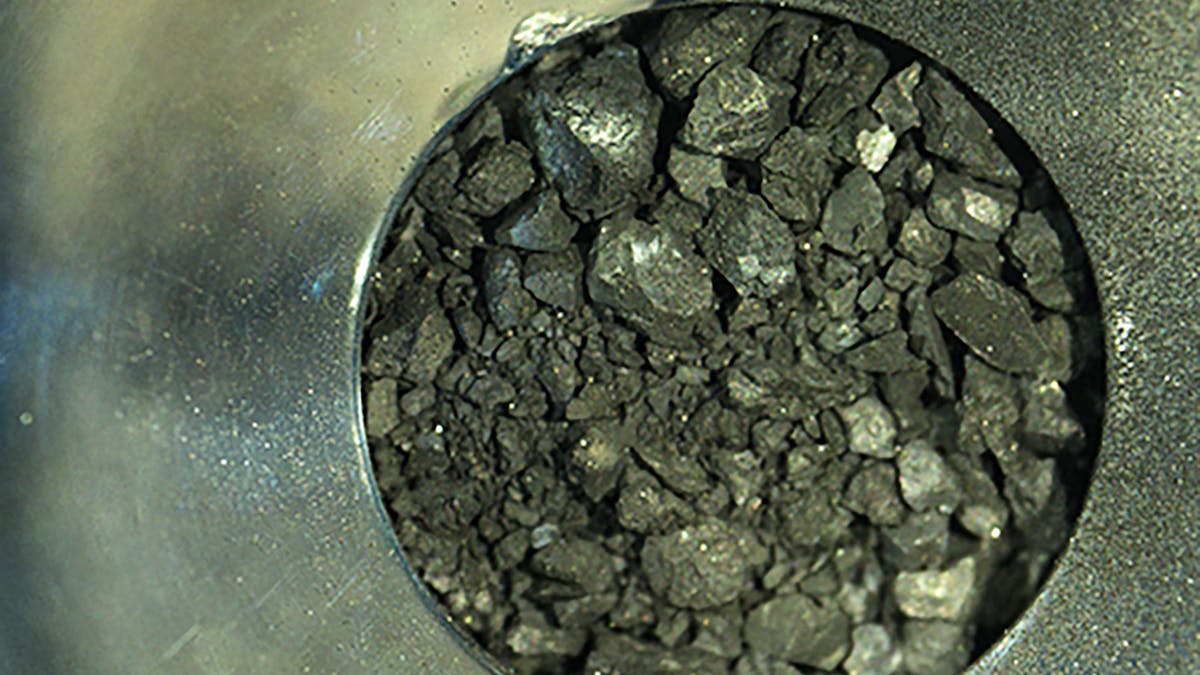
The samples taken from the asteroid Ryugu contain all the bases of DNA and RNA, suggesting that these key elements of life, already detected on the celestial object Bennu, abound in the solar system.
Ryugu is one of the most primitive bodies in the solar system, containing valuable clues about its early history and the conditions that existed when life could have formed on our planet.
In 2014, the Japanese probe Hayabusa-2 went to meet it some 300 million kilometers from Earth and brought back two samples of 5.4 grams.
A first study, published in 2023, revealed the presence of uracil, one of the four basic building blocks of RNA. If DNA, with its double helix, carries genetic information, RNA, made up of a single ribbon, is a messenger allowing the implementation of the instructions contained in DNA.
New analyzes carried out by a Japanese team and unveiled Monday in “Nature Astronomy” show that the samples in fact contain all of the nitrogenous bases constituting RNA and DNA: uracil, but also adenine, guanine, cytosine and thymine.
Molecule transporters
The presence of these bases “does not mean that life existed on Ryugu or its parent body”, the primitive asteroid from which it was ejected after a collision, explains to AFP Toshiki Koga, biogeochemist at the Japan Agency for Marine and Earth Science and Technology (Jamstec) and main author of the study. Rather, it “indicates that primitive asteroids could produce and preserve molecules important for the chemistry linked to the origin of life,” he continues.
Without excluding an appearance of these molecules in the primitive oceans or even in the atmosphere of our planet, their presence “generalized throughout the solar system”, reinforces “the hypothesis according to which carbonaceous asteroids contributed to the prebiotic chemical inventory (before the appearance of life, editor’s note) of the early Earth,” notes the study.
Previous discoveries
These results are “neither surprising nor new, and this is precisely where their interest lies”, reacted to the Science Media Center organization César Menor Salvan, astrobiologist at the University of Alcalá (Spain), for whom scientists now have a “very clear idea of the organic materials that can form in prebiotic conditions anywhere in the Universe”.
This is not the first time that these elementary building blocks of life have been found on materials of extraterrestrial origin. Last year, studies had already revealed their presence in fragments of the asteroid Bennu, brought back to Earth by NASA. Scientists have also found them on the Orgueil and Murchinson carbonaceous meteorites, fragments of asteroids that fell to Earth.
Koga and his colleagues conducted comparative studies and discovered significant differences in the proportion of each nitrogen base in these samples.
Ryugu contains comparable amounts of purine bases (adenine and guanine) and pyrimidine bases (cytosine, thymine, and uracil), which assemble in pairs to form DNA. The Murchison meteorite is richer in purine bases, while Bennu and Orgueil are richer in pyrimidine bases.
According to the authors, these results likely reflect the “distinct chemical and evolutionary histories” of their respective parent bodies.
A still little-known synthesis route
The researchers also highlighted the existence of a correlation between the ratio of purine bases/pyrimidine bases and the concentration of another nitrogen molecule, ammonia.
“No known formation mechanism predicts such a relationship, which could indicate a still unknown synthesis pathway for the formation of nucleic bases in the materials of the primitive solar system,” underlines Mr. Koga to AFP.
A discovery which “has major implications for understanding how biologically important molecules were able to originally form and promote the genesis of life on Earth,” said Morgan Cable, lecturer in space sciences at Victoria University of Wellington (New Zealand), in a reaction to the NGO Australian science media center.
